The ideal of a gentleman, or, A mirror for gentlefolks : a portrayal in literature from the earliest times / by A. Smythe-Palmer.
- Abram Smythe Palmer
- Date:
- [1908]
Licence: In copyright
Credit: The ideal of a gentleman, or, A mirror for gentlefolks : a portrayal in literature from the earliest times / by A. Smythe-Palmer. Source: Wellcome Collection.
162/542 page 146
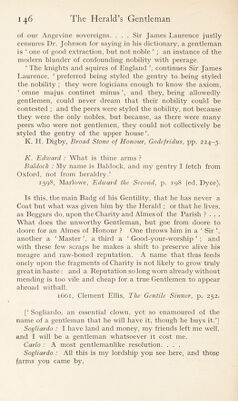
![of our Angevine sovereigns. . . . Sir James Laurence justly censures Dr, Johnson for saying in his dictionary, a gentleman is ‘ one of good extraction, but not noble ’ ; an instance of the modern blunder of confounding nobility with peerage. ‘ The knights and squires of England ’, continues Sir James Laurence, ‘ preferred being styled the gentry to being styled the nobility ; they were logicians enough to know the axiom, ‘ omne majus continet minus ’, and they, being allowedly gentlemen, could never dream that their nobility could be contested ; and the peers were styled the nobility, not because they were the only nobles, but because, as there were many peers who were not gentlemen, they could not collectively be styled the gentry of the upper house’. K. H, Digby, Broad Stone of Honour, Godefridus, pp. 224-5. K. Edward : What is thine arms ? Baldock : My name is Baldock, and my gentry I fetch from Oxford, not from heraldry.’ 1598, Marlowe, Edward the Second, p. 198 (ed, Dyce). Is this, the main Badg of his Gentility, that he has never a Coat but what was given him by the Herald ; or that he lives, as Beggars do, upon the Charity and Aimes of the Parish ? . . , What does the unworthy Gentleman, but goe from doore to doore for an Aimes of Honour ? One throws him in a ‘ Sir ’, another a ‘ Master ’, a third a ‘ Good-your-worship ’ ; and with these few scraps he makes a shift to preserve alive his meagre and raw-boned reputation. A name that thus feeds onely upon the fragments of Charity is not likely to grow truly great in haste : and a Reputation so long worn already without mending is too vile and cheap for a true Gentlemen to appear abroad withall. 1661, Clement Ellis, The Gentile Sinner, p. 252. [‘ Sogliardo, an essential clown, yet so enamoured of the name of a gentleman that he will have it, though he buys it.’] Sogliardo : I have land and money, my friends left me well, and I will be a gentleman whatsoever it cost me. Carlo : A most gentlemanlike resolution. , . . Sogliardo : All this is my lordship yop see here, and tjio.sg fgrms you came by,](https://iiif.wellcomecollection.org/image/b29008529_0164.jp2/full/800%2C/0/default.jpg)