The ideal of a gentleman, or, A mirror for gentlefolks : a portrayal in literature from the earliest times / by A. Smythe-Palmer.
- Abram Smythe Palmer
- Date:
- [1908]
Licence: In copyright
Credit: The ideal of a gentleman, or, A mirror for gentlefolks : a portrayal in literature from the earliest times / by A. Smythe-Palmer. Source: Wellcome Collection.
60/542 page 44
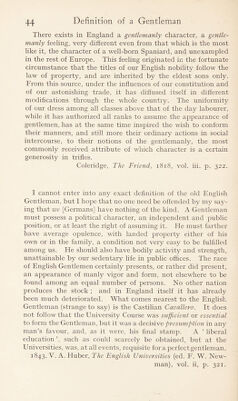
![There exists in England a gentlemanly character, a gentle- manly feeling, very different even from that which is the most like it, the character of a well-born Spaniard, and unexampled in the rest of Europe. This feeling originated in the fortunate circumstance that the titles of our English nobility follow the law of property, and are inherited by the eldest sons only. From this source, under the influences of our constitution and of our astonishing trade, it has diffused itself in different modifications through the whole country. The uniformity of our dress among all classes above that of the day labourer, while it has authorized all ranks to assume the appearance of gentlemen, has at the same time inspired the wish to conform their manners, and still more their ordinary actions in social intercourse, to their notions of the gentlemanly, the most commonly received attribute of which character is a certain generosity in trifles. Coleridge, The Friend, i8i8, vol. hi. p. 322. I cannot enter into any exact definition of the old English Gentleman, but I hope that no one need be offended by my say- ing that we [Germans] have nothing of the kind. A Gentleman must possess a political character, an independent and public position, or at least the right of assuming it. He must farther have average opulence, with landed property either of his own or in the family, a condition not very easy to be fulfilled among us. He should also have bodily activity and strength, unattainable by our sedentary life in public offices. The race of English Gentlemen certainly presents, or rather did present, an appearance of manly vigor and form, not elsewhere to be found among an equal number of persons. No other nation produces the stock ; and in England itself it has already been much deteriorated. What comes nearest to the English Gentleman (strange to say) is the Castilian Cavallero. It does not follow that the University Course was su'^icient or essential to form the Gentleman, but it was a decisive presumption in any man’s favour, and, as it were, his final stamp. A ' liberal education such as could scarcely be obtained, but at the Universities, was, at all events, requisite fora perfect gentleman. 1843, V. A. Huber, The English Universities (ed. F. W. New- man), vol. ii, p. 321.](https://iiif.wellcomecollection.org/image/b29008529_0062.jp2/full/800%2C/0/default.jpg)