The ideal of a gentleman, or, A mirror for gentlefolks : a portrayal in literature from the earliest times / by A. Smythe-Palmer.
- Abram Smythe Palmer
- Date:
- [1908]
Licence: In copyright
Credit: The ideal of a gentleman, or, A mirror for gentlefolks : a portrayal in literature from the earliest times / by A. Smythe-Palmer. Source: Wellcome Collection.
96/542 page 80
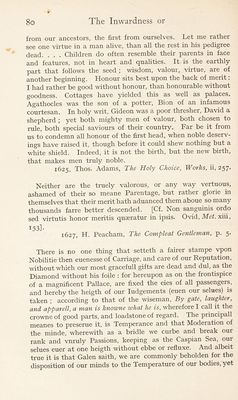
![from our ancestors, the first from ourselves. Let me rather see one virtue in a man alive, than all the rest in his pedigree dead. . . . Children do often resemble their parents in face and features, not in heart and qualities. It is the earthly part that follows the seed ; wisdom, valour, virtue, are of another beginning. Honour sits best upon the back of merit: I had rather be good without honour, than honourable without goodness. Cottages have yielded this as well as palaces. Agathocles was the son of a potter, Bion of an infamous courtesan. In holy writ, Gideon was a poor thresher, David a shepherd ; yet both mighty men of valour, both chosen to rule, both special saviours of their country. Far be it from us to condemn all honour of the first head, when noble deserv- ings have raised it, though before it could shew nothing but a white shield. Indeed, it is not the birth, but the new birth, that makes men truly noble. 1625, Thos. Adams, The Holy Choice, Works, ii, 257. Neither are the truely valorous, or any way vertuous, ashamed of their so meane Parentage, but rather glorie in themselves that their merit hath aduanced them aboue so many thousands farre better descended. [Cf. Non sanguinis ordo sed virtutis honor mentis quseratur in ipsis. Ovid, xiii, 153]- 1627, H. Peacham, The Compleat Gentleman, p. 5. There is no one thing that setteth a fairer stampe vpon Nobilitie then euenesse of Carriage, and care of our Reputation, without which our most gracefull gifts are dead and dul, as the Diamond without his foile : for hereupon as on the frontispice of a magnificent Pallace, are fixed the eies of all passengers, and hereby the heigth of our ludgements (euen our selues) is taken ; according to that of the wiseman. By gate, laughter, and apparell, a man is knowne what he is, wherefore I call it the crowne of good parts, and loadstone of regard. The principall meanes to preserue it, is Temperance and that Moderation of the minde, wherewith as a bridle we curbe and break our rank and vnruly Passions, keeping as the Caspian Sea, our selues euer at one heigth without ebbe or refiuxe. And albeit true it is that Galen saith, we are commonly beholden for the disposition of our minds to the Temperature of our bodies, yet](https://iiif.wellcomecollection.org/image/b29008529_0098.jp2/full/800%2C/0/default.jpg)