A mirror for medicine : some resources of the Wellcome Institute Library an exhibition, Monday 19 October - Friday 18 December 1987.
- Wellcome Historical Medical Library
- Date:
- 1987
Licence: Attribution 4.0 International (CC BY 4.0)
Credit: A mirror for medicine : some resources of the Wellcome Institute Library an exhibition, Monday 19 October - Friday 18 December 1987. Source: Wellcome Collection.
32/44 page 30
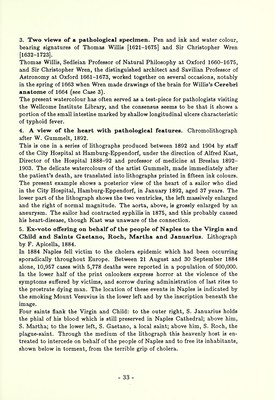
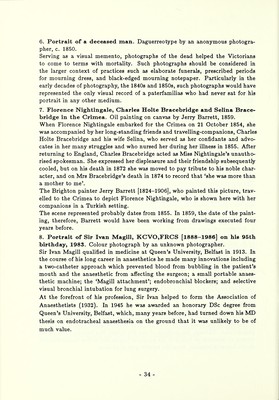
![5. Francisco Gonzalez Laguna. El zelo sacerdotal para con los ninos no- nacidos. Lima: Imprenta de los Ninos Exp6sitos. 1781. This small work instructing priests on caesarean section may be taken as a type of numerous Enlightenment attempts to improve imperial medical provision from the metropolis. It emphasises signs indicating the death of the mother, describes the operation in simple terms, and urges the desirability for mothers to nurse their own offspring. Similar works on caesarean section were published within the Spanish Empire in accordance with the policy of Carlos III [1759-88], first pursued in his Kingdom of Naples (as Carlos IV of Naples, 1734-50). The author, a distinguished priest, is regarded as one of the founders of the Enlightenment in Lima. 6. Gazetas de Mexico. 16 vols. Mexico: F. de Zuiiiga y Ontiveros [&c]. 1784-1809. One of a series of sets of the official journal of New Spain (considerably larger than present day Mexico), running - sporadically - from 1722 to 1821, this series of the Gazeta remains a primary printed source for general information on the colony. It includes viceregal proclamations, minting and trade returns, shipping news, major obituaries, and news and comments of medical interest; and especially notices and instructions on vaccination (1804, XII (num.13), p. 97) during the years of the valiant world-encircling Vaccination Expedition (1803-6) of Carlos IV of Spain. 7. Benjamin Rush [1745-1813]. An account of the bilious remitting yel- low fever as it appeared in the city of Philadelphia in the year 1793. Philadelphia: T. Dobson. 1794. Yellow fever, understandably thought by Rush to be 'propagated chiefly by ex- halation from the putrid coffee' on the Philadelphian wharves, was attacked by this observant and determined physician by means of his stern depleting regimen - heroic purges of calomel and jalap (pp. 200-201) in order to raise the pulse - with copious bleeding, cool air, cold drinks, temperate vegetable diet, and topi- cal application of cold water. His method claimed, perhaps justly, considerable success. 8. Pharmacopoeia of the United States of America. Boston: Wells and Lilly for C. Ewer. 1820. The Pharmacopoeia, which signals the independence of medicine in the U.S.A., was drafted by a governmentally-sponsored committee set up following a sub- mission in 1817 to the New York County Medical Society. The preface records how in the United States 'the evil of irregularity and uncertainty in the prepa- ration of medicines has been felt with peculiar weight'. The formulary is both traditional (in both Latin and English) and exploratory (American plants are substituted for European where appropriate). 9. Arthur Wellington Clah [1831-1916]. Journals, account-books and note- books of a Tsimshian Indian. 72 items. Port Simpson, B.C., Canada &c, - 30-](https://iiif.wellcomecollection.org/image/b20456852_0032.jp2/full/800%2C/0/default.jpg)