[Report 1950] / Medical Officer of Health and School Medical Officer of Health, East Riding of Yorkshire County Council.
- East Riding of Yorkshire (England). County Council
- Date:
- 1950
Licence: Attribution 4.0 International (CC BY 4.0)
Credit: [Report 1950] / Medical Officer of Health and School Medical Officer of Health, East Riding of Yorkshire County Council. Source: Wellcome Collection.
26/78 (page 22)
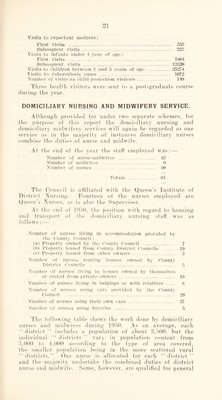
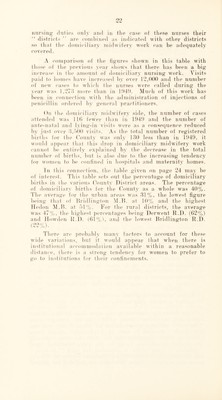
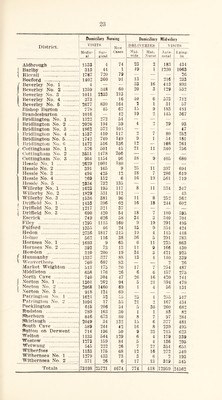
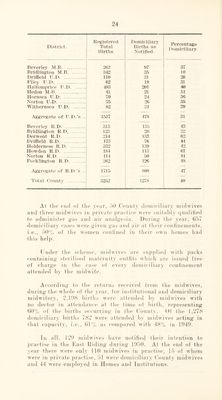
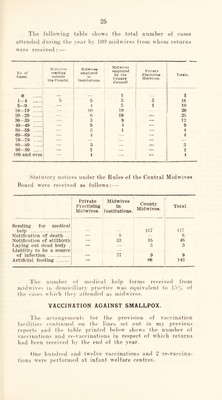
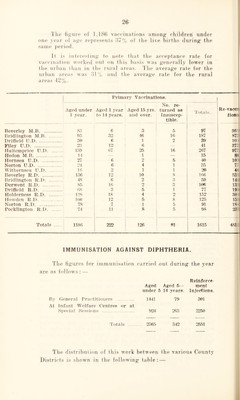
![luirsino- (hities only and in tlie case of these nurses their (listi‘i(ds ” ai'e (‘onibined as indicated with other districts so that the doniici 1 iai'v midwifery work can he adequately ('overed. A com]nn'ison of the fionres shown in this table with those of the ])i‘evi(ms yeai* shows tliat tliere has been a big' increast' in <hc amount of domi(‘iliary nursing' work. Visits paid lo homes have inci'ensed by over 12,(H)0 and the number of new cases to whi(*h the nurses were (‘ailed during the yeai' was l,27d more than in Iddl). Alueh of this work has bt'en in connt‘ction wilh the administj'ation of injections of penicillin o7‘dto’('d by gemo'al ])ractitione7‘S. ()n the domiciliary 7nidwifery side, the 7iumber of cases attended was lit) fewe7' than i7i 1941) a77d the innuber of a7ite-natal and Iyi7ig-i7i visits we7‘e as a (‘07isequence reduced by just ov('7' 'bdiltl visits. As the total 7iu7nber of registered birlhs for tlu' (k)i7nty was only IdO less than i7i 1949, it would a])))ea7' that this d7'o]) in do7ni(*iliary midwifery work ca7i7)ot bt‘ e7iti7‘ely explained by the decrease i7i the total ninnbei' of births, but is also due to the i77ereasi7ig 1e7uleucv fo7‘ wo7n(‘n to be (‘onfined in hos])itals a7Hl 7nateruity homes. l7i this (‘071 (lection, tlu' table giv(m on page 24 may be of interest. This table sets out the ])ercentiage of domi(‘iliary births in the various (\u7nty l)istri(‘t areas. The percentage of domiciliary births for the (kmnty as a whole was 40%. 'The average for the uiban areas was dl%, the loAvest figure being that of Hridlington V.ll, at 10% and the highest fiedon Al.lk at 7)1%. For the rural districts, the average was 47%. the highest ])er(‘entages being Derwent 11.1). (62%) and Ilowden Iv.l). (61%), and the lowest Bridlington B.D. I OO o/ \ \ ^ /(') / • ddiere ari' jirobably many factors to acimunt for these wide variations, but it would a])])ear that when there is institutional ac(‘oniniodation available within a reasonable distarn'c, tliei'e is a strong tendency for women to prefer to go to institutions for their confinements.](https://iiif.wellcomecollection.org/image/b29185580_0026.jp2/full/800%2C/0/default.jpg)