[Report 1950] / Medical Officer of Health and School Medical Officer of Health, East Riding of Yorkshire County Council.
- East Riding of Yorkshire (England). County Council
- Date:
- 1950
Licence: Attribution 4.0 International (CC BY 4.0)
Credit: [Report 1950] / Medical Officer of Health and School Medical Officer of Health, East Riding of Yorkshire County Council. Source: Wellcome Collection.
33/78 (page 29)
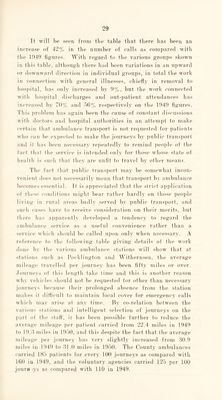
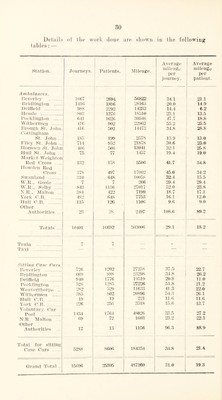
![Tt will be seen from tlie table that there has been an inerease of 42% in the number of rails as compared with tlie 1949 fio’ures. With reo^ard to tlie various o‘roups sliown in this table, although there Imd been variations in an ipnvard OT' downward direction in individual o^oups, in total the work in connection with o’eneral illnesses, (diiefly in removal to hos])ital, has only increased by 9%, but the work (mnnected will) hospital discharo'cs and out-patient attendam'es has increased by 70% and b0%, respectively on the 1949 fio^ures. This ])roblem has a^‘ain been the cause of (‘onstant discussions with do(‘tors and hos]utal authorities in an attempt to make ceidain that ambulance transport is not re(]uested for patients who can be ex])ected to make the journeys by public* transport and it has been necessary repeatedly to remind ])eo])le of the fac't that the servi(‘e is intended only for those whose state of health is such that they are unfit to travel by other means. Tin* fa(*t that ]'>ublic ti’anspoid may be somewhat incon- venient does not necessarily mean that trans])ort by ambulance becomes essential. It is ap])i‘eciated that the strict application of thc*se (‘onditions mi.oht bear rathei' hardly on tliose ])eople livino' in rural ai‘eas badly served by ]uiblic trans])()rt, and such cases have to re(‘eive (‘onsideration on their merits, but there has a|)])arently develo])e(l a tendency to regard the ambulance service as a useful (*onvenience rather than a service whicli should be called upon only when necessary. A I'eference to the following* table ^uvino' details of the work done by tlie vaia’ous ambulanc'e stations will show that at stations such as Pocklinf>*ton and Withernsea, the average mileage ti'avelled per journey has been fifty miles or over. Journeys of this length take time and this is another reason why vehicles should not be requested for other than necessary journeys bec'ause their ])rolonged absence from the station makes it difficult to maintain local covei* for emergency calls which may arise at any time. By co-relation between the various stations and intelligent selection of journeys on the ])art of the staff, it has been possible further to reduce the average mileage per jiatient (‘arried from 22.4 miles in 1949 to 19.4 miles in 19o(), and this despite the fact that the average mileage pei* journey has very slightly increased from 30.9 miles ill 1949 to 31.0 miles in 1950. The County ambulances carried 185 patients for every 100 journeys a-s compared with 160 in 1949, and the voluntary agencies carried 125 per 100 journ lys as compared with 110 in 1949,](https://iiif.wellcomecollection.org/image/b29185580_0033.jp2/full/800%2C/0/default.jpg)