Licence: In copyright
Credit: Hygiene: a manual of personal and public health. Source: Wellcome Collection.
Provider: This material has been provided by London School of Hygiene & Tropical Medicine Library & Archives Service. The original may be consulted at London School of Hygiene & Tropical Medicine Library & Archives Service.
356/372 (page 344)
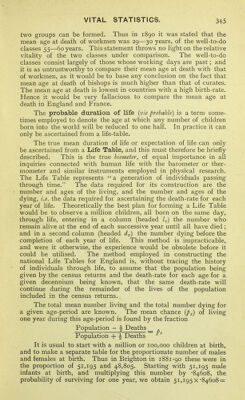
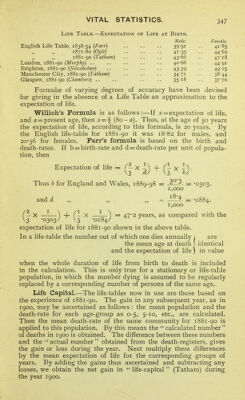
![HYGI ENE. England and Wales, 1899. Deaths from Various Causes to 10,000 Deaths from all Causes. BvoncJiiiis 880 Influenza Phthisis .. 72Q Whooping cough Pneumonia 685 Measles .. 111 Old age .. •• ' ' Diphtheria 160 Diarrhoea, Dysentery 511 Enteric fever 108 Cancer .. . . 452 Scarlet fever .. 64 Apoplexy . . .. .. 3 The diseases in the second column are given in order to indicate their proportional share of the total number of deaths. The proper plan of stating the death-rate from a given disease is in terms of the population, or better still sub-divided into death- rates from the disease for different age-groups as in the table on page 340, if the number of deaths is not too small to admit of this. The importance of stating the death-rate for different age-groups is greatest for such diseases as diarrhoea, whooping cough, and measles, in which most of the deaths occur at ages under five. In the following table are given the death-rates from the causes of death which are most important, either from their magnitude, or because of their preventible character :— England and Wales, 1899.—Death-rate per 1,000 Persons living. Small-pox .. •005 Intemperance •09- Bronchitis i-6i Measles •32 Cancer ■83 Pneumonia I'26 Scarlet fever •12 Phthisis .. 1-34) Gastro-enteritis .. •61 Influenza •39 Other tubercular 1- Bright's disease .. •29 Whooping cough •32 diseases •58] Accidents .. •59 Diphtheria .. •29 Premature birth .. •58 /// defined and not Enteric fever •20 Old age •99 specified causes .. •73 Typhus fever •001 Apoplexy .. •60 Cholera •04 Convulsions ■57 •38 A11 causes.. 18-33 Diarrhoea, Dysentery •94 Valvular disease of heart . . Determination of Longevity. We have hitherto considered only death-rates, i.e. the number dying each year out of each 1,000 of population. The mean duration of life involves another aspect of the same problem. Although nothing is more uncertain than the duration of individual life, the duration of life for the entire community is subject to so little variation that annuities and life assurance can be made the subject of exact calculations. Of the tests employed to measure the duration of human life the most commonly employed is the mean age at death.f Mean age at death= sum of ages at death. _ xhis is a fair method number 01 deaths. of stating the average longevity oi a particular group of persons, if the group is sufficiently large to avoid the possible error caused by paucity of data (page 349). But it would be entirely unsafe to assume that by this means a safe standard of comparison between * The death-returns greatly understate the actual death-rate from this cause. t There is no general agreement as to the exact sense in which the words average and 7nean should be used. They are used here interchangeably.](https://iiif.wellcomecollection.org/image/b21357675_0356.jp2/full/800%2C/0/default.jpg)