Licence: In copyright
Credit: Hygiene: a manual of personal and public health. Source: Wellcome Collection.
Provider: This material has been provided by London School of Hygiene & Tropical Medicine Library & Archives Service. The original may be consulted at London School of Hygiene & Tropical Medicine Library & Archives Service.
45/372 (page 33)
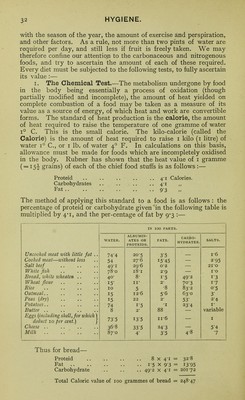
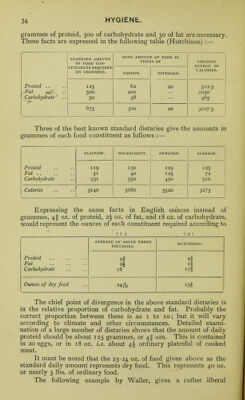
![The total fuel value in Calories of one pound of certain typical foods is given by Hutchison as follows :—Butter 3,577, peas 1,473, cheese 1,303, bread 1,128, eggs 739, beef 623, potatoes 369, milk 322, fish (cod) 315, apples 238. 2. The Physiological Test.—Not only is a proper proportion of proteid, fat, and carbo-hydrates required, but these must be capable of digestion and absorption and of oxidation in the body. Cheese is a highly concentrated food, but its value is less than its percentage composition would indicate, because of the difficulty of digesting considerable quantities of it. Green vegetables consist largely of cellulose, which is only imperfectly capable of absorption into the blood, although it can experimentally be oxidised by combustion. The proportion between absorbed food and food rejected in the foeces can be ascertained by analysis. Many experiments made on these lines show that on a purely animal diet (meat, eggs, milk) but little nitrogen is lost, while with vegetable foods (carrots, potatoes, peas, etc.) the waste of nitrogen is considerable. Fats are very completely absorbed from the alimentary canal. The amount remaining unabsorbed is greatest with mutton fat (10 per cent.), least with butter (2f per cent.). Experimentally it has been found that an amount up to 150 grammes (about 5|- oz.) of fat can be absorbed without appreciable loss. Carbohydrates are very completely absorbed, even starchy foods rarely escaping digestion. Completeness of absorption from the alimentary canal is not desirable for all foods ; a certain amount of unabsorbed residue is required to stimulate peristalsis. With a purely vegetable diet this amount is excessive, and there is physiological waste of effort. 3. In practical dietetics the Economic test is important. Carbohydrate is by far the cheapest food, and generally vegetable are cheaper than animal foods. Thus a shilling's-worth of bread yields 10,764 Calories, while the same sum spent on milk would only yield ^, and on beef this number of heat units. Similarly a shilling's-worth of peas contains 572 grammes of proteid, about double as much as the same money's-worth of cheese ; while to obtain the same amount of proteid from eggs would cost more than eight, and from beef more than five times as much as from peas (Hutchison). The market price of foods is no certain indication of their nutritive value. Thus haddock will supply as much nutriment as sole at a fourth of the cost; Dutch as much nutriment as Stilton cheese at less than half the cost. Similarly the most economical fats are margarine and dripping. 4. An Examination of Actual Dietaries under various conditions has strikingly confirmed the results obtained by other methods. It has been found that {a) the potential energy required by a healthy man weighing 11 stones, and doing a moderate amount of muscular work is 3,000 to 3,500 Calories ( = 310 grains); and that {h) about 20 granames of nitrogen and 320 grammes ( = 4,960 grains) of carbon are excreted by such a man. {c) Expressing the 3,000 Calories required in terms of grammes of food, it is found that 125 Newsholme's Hygiene,] 4](https://iiif.wellcomecollection.org/image/b21357675_0045.jp2/full/800%2C/0/default.jpg)