Catalogue of the bronzes, Greek, Roman, and Etruscan, in the Department of Greek and Roman Antiquities, British Museum / by H.B. Walters.
- British Museum. Department of Greek and Roman Antiquities
- Date:
- 1899
Licence: Public Domain Mark
Credit: Catalogue of the bronzes, Greek, Roman, and Etruscan, in the Department of Greek and Roman Antiquities, British Museum / by H.B. Walters. Source: Wellcome Collection.
122/536 page 48
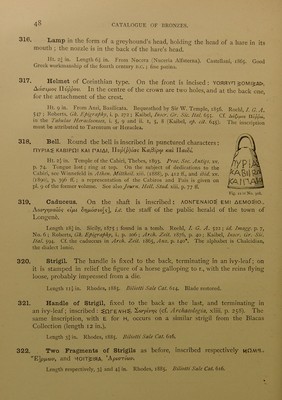
![43 316. 317. 318. 319. 320. 321. 322. Lamp in the form of a greyhound’s head, holding the head of a hare in its mouth ; the nozzle is in the back of the hare’s head. Ht. 2-1 in. Length 6% in. From Nocera (Nuceria Alfaterna). Castellani, 1865. Good Greek workmanship of the fourth century li.c. ; fine patina. Helmet of Corinthian type. On the front is incised: YOflflYH ^OMi^A>, Ado-t/409 11 vppov. In the centre of the crown are two holes, and at the back one, for the attachment of the crest. Ht. 9 in. From Anzi, Basilicata. Bequeathed by Sir W. Temple, 1856. Roehl, I. G. A. 547 ; Roberts, Gk. Epigraphy, i. p. 272 ; Kaibel, Inscr. Gr. Sic. Ital. 655. Cf. nbppco, in the Tabulae Heracleenses, i. 5, 9 and ii. 1, 5, 8 (Kaibel, op. cit. 645). The inscription must be attributed to Tarentum or Heraclea. Bell. Round the bell is inscribed in punctured characters : nYPIA^ KABlPdl KAI PAIAI, IIvp(p)la<; Kafilpw kcil IIcuBL Ht. 2\ in. Temple of the Cabiri, Thebes, 1893. Proc. Soc. Antiqs. xv. p. 74. Tongue lost; ring at top. On the subject of dedications to the Cabiri, see Winnefeld in Athen. Mittheil. xiii. (1888), p. 412 fif., and ibid. xv. (1890), p. 396 fif. ; a representation of the Cabiros and Pais is given on pi. 9 of the former volume. See also Journ. Hell. Stud. xiii. p. 77 fif. Caduceus. On the shaft is inscribed: AONrENAl05> EMI AEMO^IO., Aov'yrjvaLo^ eifu hr] gou Lo\y\ i.e. the staff of the public herald of the town of Longenfb. Length i8jin. Sicily, 1875 5 found in a tomb. Roehl, I. G. A. 522; id. hnagg. p. 7, No. 6; Roberts, Gk. Epigraphy, i. p. 206; Arch. Zeit. 1876, p. 40; Kaibel, Inscr. Gr. Sic. Ital. 594. Cf. the caduceus in Arch. Zeit. 1865, Ans. p. 140*. The alphabet is Chalcidian, the dialect Ionic. Strigil. The handle is fixed to the back, terminating in an ivy-leaf; on it is stamped in relief the figure of a horse galloping to r., with the reins flying loose, probably impressed from a die. Length n|-in. Rhodes, 1885. Biliotti Sale Cat. 614. Blade restored. Handle of Strigil, fixed to the back as the last, and terminating in an ivy-leaf; inscribed: 5>QrE/VH<:. Scoyevris (cf. Archaeologia, xliii. p. 258). The same inscription, with E for H, occurs on a similar strigil from the Blacas Collection (length 12 in.). Length 3f in. Rhodes, 1885. Biliotti Sale Cat. 616. Two Fragments of Strigils as before, inscribed respectively hCMTi 'E]p/xwv, and MOIT^IBA, ’Apiariwv. Length respectively, 3! and 4§ in. Rhodes, 1885. Biliotti Sale Cat. 616.](https://iiif.wellcomecollection.org/image/b24876380_0122.jp2/full/800%2C/0/default.jpg)



 No text description is available for this image
 No text description is available for this image
 No text description is available for this image