Prostitution : considered in its moral, social, and sanitary aspects, in London and other large cities and garrison towns: with proposals for the control and prevention of its attendant evils / by William Acton.
- William Acton
- Date:
- 1870
Licence: Public Domain Mark
Credit: Prostitution : considered in its moral, social, and sanitary aspects, in London and other large cities and garrison towns: with proposals for the control and prevention of its attendant evils / by William Acton. Source: Wellcome Collection.
Provider: This material has been provided by Royal College of Physicians, London. The original may be consulted at Royal College of Physicians, London.
151/328 (page 131)
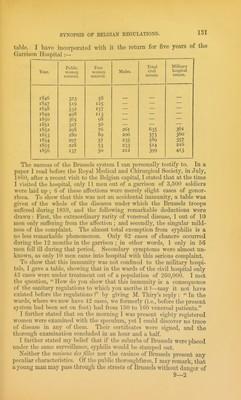
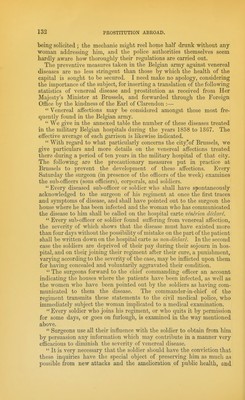
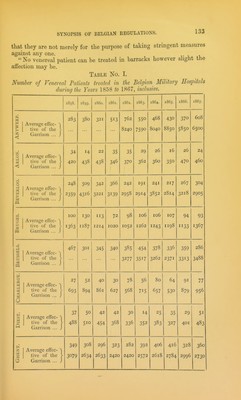
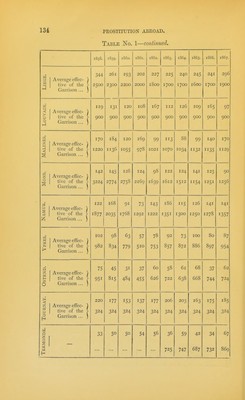
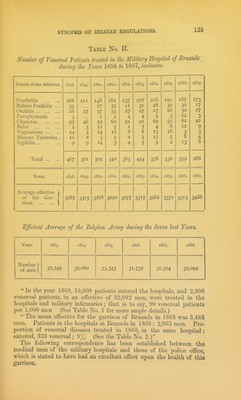
![table. I have incorporated with it the return for five years of tho Garrison Hospital:— Year. Public women entered. Free women entered. Males. Total civil return. Military hospital return. 1846 323 58 — — 1847 125 184S 532 157 1849 498 113 1850 365 98 1851 327 56 1852 29S 76 261 635 361 1853 280 89 206 575 360 1854 297 57 235 589 357 1855 228 53 233 514 216 1856 137 50 212 399 413 The success of the Bmssels system I can personally testify to. In a paper I read before the Royal ]\Iedical and Chirurgical Society, in July, 18G0, after a recent visit to the Belgian capital, I stated that at the time I visited the hospital, only 11 men out of a garrison of 3,500 soldiers were laid up ; G of these affections were merely slight cases of gonor- rhoea. To show that this AA'as not an accidental immunity, a table was given of the whole of the diseases under which the Brussels troops suffered during 1859, and the following remarkable deductions were drawn : First, the extraordinary rarity of venereal disease, 1 out of 10 men only suffering from the affection; and secondly, the singular mild- ness of the complaint. The almost total exemption from syphilis is a no less remarkable phenomenon. Only 62 cases of chancre occurred during the 12 months in the garrison ; in other words, 1 only in 55 men fell ill during that period. Secondary symptoms were almost un- known, as only 10 men came into hospital with this serious complaint. To show that this immunity was not confined to the military hospi- tals, I gave a table, showing that in the wards of the civil hospital only 42 cases were under treatment out of a population of 200,000. I met the question, How do you shoAv that this immunity is a consequence of the sanitary regulations to wliich you ascribe it 1—may it not have existed before the regulations V by giving M. Thiry's reply : In the wards, where we now have 42 cases, we formerly (i.e., before the present system had been set on foot) had from 150 to IGO venereal patients. I further stated that on the morning I was present eighty registered women were examined with the speculum, yet I could discover no trace of disease in any of them. Their certificates were signed, and the thorough examination concluded in an hour and a half. I furtiicr stated my belief that if the suburbs of Brussels were placed under the same surveillance, syphilis would be stamped out. Neither the maisons des fiUes nor the casinos of Brussels present any peculiar characteristics. Of the i)ublic thoroughfares, I may remark, that a young man may pass through the streets of Brussels without dan^^cr of 9—2 °](https://iiif.wellcomecollection.org/image/b22650179_0151.jp2/full/800%2C/0/default.jpg)