Prostitution : considered in its moral, social, and sanitary aspects, in London and other large cities and garrison towns: with proposals for the control and prevention of its attendant evils / by William Acton.
- William Acton
- Date:
- 1870
Licence: Public Domain Mark
Credit: Prostitution : considered in its moral, social, and sanitary aspects, in London and other large cities and garrison towns: with proposals for the control and prevention of its attendant evils / by William Acton. Source: Wellcome Collection.
Provider: This material has been provided by Royal College of Physicians, London. The original may be consulted at Royal College of Physicians, London.
22/328 (page 2)
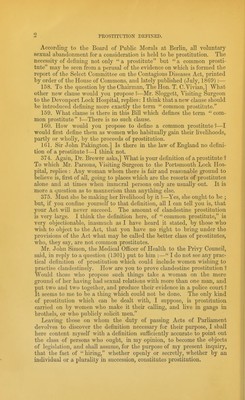
![9 PROSTITUTION DEFINED. Is there in the law of England no defini- V not. According to the Board of Public Morals at Berlin, all voluntary- sexual abandonment for a consideration is held to be prostitution. The necessity of defining not only a prostitute but a common prosti- tute may be seen from a perusal of tlie evidence on which is formed the report of the Select Committee on the Contagious Diseases Act, printed by order of tlie House of Commons, and lately pu])lished (July, 1869):— 158. To the question by the Chairman, The Hon. T. C. Vivian,] Wliat other new clause would you propose 1—Mr. Sloggett, Visiting Surgeon to the Devonport Ijock Hospital, replies: I think that a new clause should be introduced defining more exactly the term common prostitute. 159. What clause is there in this Bill which defines the term com- mon prostitute 1—There is no such clause. 160. How would you propose to define a common prostitute?—I would first define them as women who habitually gain their livelilioods, partly or wholly, by the proceeds of prostitution. 161. Sir John Pakington. tion of a prostitute 1—I thin 374. Again, Dr. Brewer asks,] What is your definition of a prostitute 1 To which Mr. Parsons, Visiting Surgeon to the Portsmouth Lock Hos- pital, replies : Any woman whom there is fair and reasonable ground to believe is, first of all, going to places Avhich are the resorts of prostitutes alone and at times when immoral jDersons only are usually out. It is more a question as to mannerism than anything else. 375. Must she be making her livelihood by it ?—Yes, she ought to be ; but, if you confine yourself to that definition, all I can tell you is, that your Act will never succeed. The amount of clandestine prostitution is very large. I think the definition here, of common prostitute, is very objectionable, inasmuch as I have heard it stated, by those who wish to object to the Act, that you have no right to bring under the provisions of the Act what may be called the better class of prostitutes, who, they say, are not common prostitutes. Mr. John Simon, the Medical Officer of Health to the Privy Council, said, in reply to a question (1301) put to him :— I do not see any prac- tical definition of prostitution which could include women wishing to practise clandestinely. How are you to prove clandestine prostitution ? Would those Avho propose such things take a woman on the mere ground of her having had sexual relations with more than one man, and put two and two together, and produce their evidence in a police court ? It seems to me to be a thing which could not be done. The only kind of prostitution which can be dealt with, I suppose, is prostitution carried on by women who make it their calling, and live in gangs in brothels, or who publicly solicit men. Leaving those on whom the duty of passing Acts of Parliament devolves to discover the definition necessary for their purpose, I shall here content myself with a definition sufficiently accurate to point out the class of persons who ought, in my opinion, to become the objects of legislation, and shall assume, for the purpose of my present inquiry, that the fact of hiring, whether openly or secretly, whether by an individual or a plurality in succession, constitutes prostitution.](https://iiif.wellcomecollection.org/image/b22650179_0022.jp2/full/800%2C/0/default.jpg)