William Harvey : a history of the discovery of the circulation of the blood / by R. Willis ; with a portrait of Harvey, after Faithorne.
- Date:
- 1878
Licence: Public Domain Mark
Credit: William Harvey : a history of the discovery of the circulation of the blood / by R. Willis ; with a portrait of Harvey, after Faithorne. Source: Wellcome Collection.
Provider: This material has been provided by the Royal College of Physicians of Edinburgh. The original may be consulted at the Royal College of Physicians of Edinburgh.
111/406 page 91
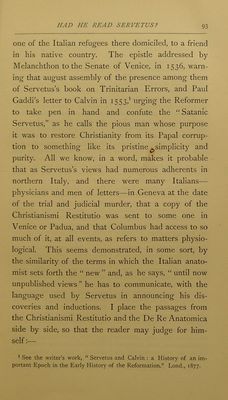
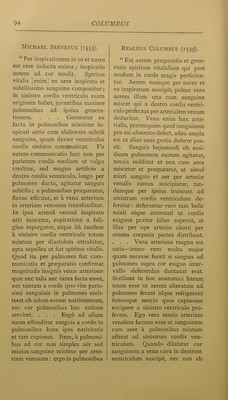
![so that nothing can return by the way it came. The valves of the aorta and pulmonary artery opening, on the contrary, at the same moment, give passage to the spirituous blood for distribution to the body at large, and to the natural blood for transference to the lungs.”1 Columbus, we have seen, denied muscularity to the heart, so that it is rather hard to imagine what he could have understood when he speaks of its contract- ing. Ascribing the pulsific power of the arteries to the spirit they contain, as he does, it is obvious that they did not beat from the shock of the heart. The heart, in short, is left by Columbus, as by the old physiology, with its diastole as the efficient element in its activity, and doubtless also with the spirit as the immediate cause of this. Columbus arrogates to himself, and has often had conceded to him, the honour of having first proclaimed the passage of the blood from the right to the left side of the heart by the way of the lungs. But in this we know that he was anticipated by Servetus; and in other important particulars of which he makes mention, he is not only not in advance of the Spaniard but decidedly in arrear of him. Neither Servetus nor Columbus was aware that the foetal heart acted precisely (diversity of structure 1 “ Idcirco, quando dilatatur cor, sanguinem naturalem a vena cava in dextrum ventriculum suscipit; necnon ab arteria venosa sanguinem paratum una cum aere in sinistrum ; [ita ut] sanguis spirituosus exiens, per totum corpus funditur, sanguisque naturalis ad pulmones delatus est.”](https://iiif.wellcomecollection.org/image/b21996404_0113.jp2/full/800%2C/0/default.jpg)