Microscopical morphology of the animal body in health and disease / by C. Heitzmann. With 380 original engravings.
- Carl Heitzmann
- Date:
- 1883
Licence: Public Domain Mark
Credit: Microscopical morphology of the animal body in health and disease / by C. Heitzmann. With 380 original engravings. Source: Wellcome Collection.
Provider: This material has been provided by the Augustus C. Long Health Sciences Library at Columbia University and Columbia University Libraries/Information Services, through the Medical Heritage Library. The original may be consulted at the the Augustus C. Long Health Sciences Library at Columbia University and Columbia University.
129/884 page 103
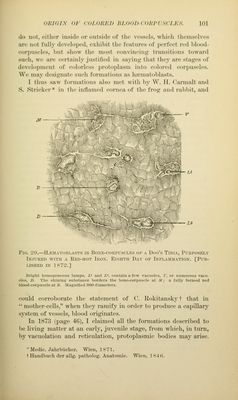
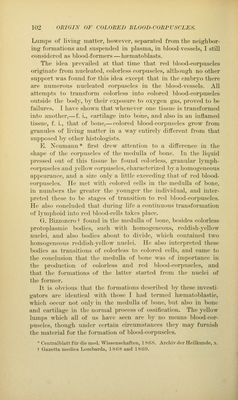
![omais OF coLoh'h'n iu.ood couitsclks. \m Based upon rcscarclu's in (•artila<;«' and Ixnu' of ])ird8, L. Scluint'v, in iSTd,* makes tlu'following statements: '' E. Neumann t has denied the new formation of red })lood- eorpuseles on the l)order of ossifieation of tlie cartihiffe. At tlu' same time he draws attention to Aeby, wlio ah-ead}' in iH.jS sn<i-i;ested sueli a new fonnation. From tlu; ([notation of Aeby's words, it foUows that he only supposed the new formation (m the border of ossification, as his researches in this direction did not yiehl positive results, wh(n*eas Heitzmann positively asserts the fact of sucli a new fonnation. E. Neumann's reasonin«;' I cannot consider correct; he, f. i., could not understand that lucnuitoblasts should stain Avith carmine, while perfect red blood-(;orpiiscles remain unstained. Heitzmann claims that the haematoblasts are in a juvenile con- dition of the protoplasm, from which, after certain changes have taken ])lace, red blood-corpuscles arise. Corpuscles may react on being stained, in a different way, in their youth and old age. E. Neumann, furthermore, makes a point of the absence of nuclei in haematoblasts, assuming, as he does, that blood- corpuscles in their juvenile condition must have nuclei, though they are destitute of such later. My own researches may also clear up this point. '' E. Metschnikowf found in the impregnated and hatched germ of fowl, at fii'st nucleated, slightly colored, and later, nucleated, distinctly colored, blood-corpuscles, and concluded that the latter had originated from the former. This conclusion is not fidly justified, as it is possible that, from the same source, at first slightly and aftei'ward deeply colored blood-corpuscles may arise and pass into the circulation without necessarily having directly changed from one into the other. The same reasoning also holds good for the blood-corpuscles of mammals. If at first nucleated and afterward non-nucleated blood-corpuscles are visible, who is willing to maintain that the latter have originated from, the former, and that each red blood-corpuscle must have had a stage of nucleation ? * Ueber den Ossificationsproeess bei Vogeln, uiid die Neubildung von rothen Blutkclrpercheu an der Ossiiieationsgrenze. Archiv fiir mikrosko- pische Anatomie. Bd. xii. t Heitzmann's Hsematoblasten. Ai'cliiv fiir mikroskopisclie Anatomie, November, IS74. + Zur Ent^vieklungsgeschiehte der rotlien Blutkorperchen. Virchow's Archiv, 41 Bd., 18G7.](https://iiif.wellcomecollection.org/image/b21219163_0129.jp2/full/800%2C/0/default.jpg)