Microscopical morphology of the animal body in health and disease / by C. Heitzmann. With 380 original engravings.
- Carl Heitzmann
- Date:
- 1883
Licence: Public Domain Mark
Credit: Microscopical morphology of the animal body in health and disease / by C. Heitzmann. With 380 original engravings. Source: Wellcome Collection.
Provider: This material has been provided by the Augustus C. Long Health Sciences Library at Columbia University and Columbia University Libraries/Information Services, through the Medical Heritage Library. The original may be consulted at the the Augustus C. Long Health Sciences Library at Columbia University and Columbia University.
42/884 page 16
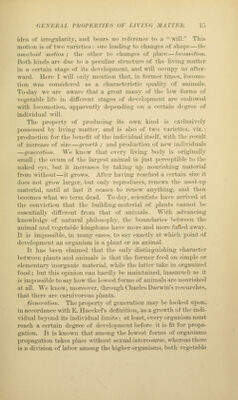
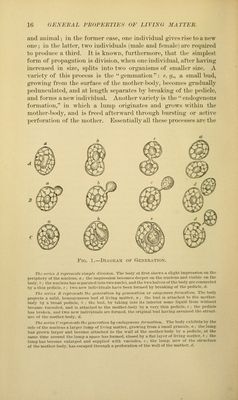
![and animal; in the former ease, one individual gives rise to a new one; in the latter, two individuals (male and fenuile) are required to produce a third. It is known, furthermore, that the simplest form of propagation is division, when one individual, after having increased in size, splits into two organisms of smaller size. A variety of this process is the gemmation': c r/., a small bud, growing fi'om the surface of the mother-])ody, becomes gradually pedunculated, and at length separates by breaking of the pedicle, and foi-ms anew indi\T:dual. Another variety is the endogenous formation, in which a lump originates and grows ^^'ithin the mother-body, and is freed afterward through bursting or active perforation of the mother. Essentially all these processes are the Fig. 1.—Diagram of Gexeratiox. The aeries A represents simple division. Tho body at first sliows a slight impression on the periphery of the nucleus, a; the impression becomes deeper on the nucleus and visible on the body. ('; the nucleus has separated into two nuclei, and tlie two halves of the body are connected by a thin pedicle, c; two new individuals have been formed by breaking of the pedicle, d. The serits B represents the yeneration by ijemmation or exogenous formation. The body projects a solid, homogeneous bud of living matter, a ; the bud is attached to the mother- body by a broad pedicle, h ; the bud, by taking into its interior some liquid from witboat became vacuoled, and is attaclied to the mother-body by a very thin pedicle, c ; the pedicle has broken, and two new individuals are formed, the original bud having assumed the struct- ure of the mother-bod.v, d. The series C represents the generation by endo(jenovs fonnation. Tlie body exhibits by the side of the nucleus a larger lump of living matter, growing from a small srranule. a ,- the lump has grown larger and become attached to the wall of the mother-l)ody by a pedicle, at the same time around the lump a space has formed, closed by a flat layer of living nuitter, b ; the lump has become enlarged and supidied with vacuoles, c; the lump, now of the structui-e of the mother-body, has escaped through a perforation of the wall of the mother, rf.](https://iiif.wellcomecollection.org/image/b21219163_0042.jp2/full/800%2C/0/default.jpg)