Microscopical morphology of the animal body in health and disease / by C. Heitzmann. With 380 original engravings.
- Carl Heitzmann
- Date:
- 1883
Licence: Public Domain Mark
Credit: Microscopical morphology of the animal body in health and disease / by C. Heitzmann. With 380 original engravings. Source: Wellcome Collection.
Provider: This material has been provided by the Augustus C. Long Health Sciences Library at Columbia University and Columbia University Libraries/Information Services, through the Medical Heritage Library. The original may be consulted at the the Augustus C. Long Health Sciences Library at Columbia University and Columbia University.
53/884 page 27
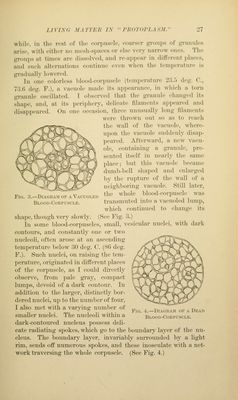
![while, ill tilt' rest (if the corjjiisclc, coarser «^r(tii]is (tf jiraiiiiles arise, with either no iMesli-si»aees or else very narrow ones. Tlie groups at times are dissolved, and re-ai)i)ear in different plaees, and such altornatious <;ontinue even when the temperature is gi'adually lowered. In one eohn-less blood-eorpuscle (temperature 2-i.') dr<x. C, 73.6 detj. F.), a vaeuole made its appearance, in which a torn o-ranule oscillated. I observed that the granule changed its shape, and, at its periphery, delicate filaments appeared and disappeared. On one occasion, three unusually long filaments were thi'own out so as to I'cacli ^..-s^.j-.-.B,.^ the wall of the vacuole, where- . upon the vacuole suddenly disap- . ^ peared. Afterward, a new vacu- ( ole, containing a granule, pre- _ T.^--OV seuted itself in nearly the same ^(^V^/ !> place; but this vacuole became ^^5=^^^ dumb-beU shaped and enlarged \ V / by the rupture of the wall of a neighboring vacuole. StiQ later, „ o Tx 17- the whole blood-corpuscle was Fig. 3.—Diagramof aVacuoled ^^^ . i n i Blood-Corpuscle. transmuted mto a vacuoled lump, which continued to change its shape, though very slowly. (See Fig. 3.) In some blood-corpuscles, small, vesicular nuclei, with dark contours, and constantly one or two nucleoH, often arose at an ascending temperature below^ 30 deg. C {S6 deg. F.). Such nuclei, on raising the tem- perature, originated in different places of the coipuscle, as I could dii-ectly observe, from pale gray, compact lumps, devoid of a dark contour. In addition to the larger, distinctly boi-- dered nuclei, up to the nuniljcr of four, I also met with a varving number of ^ , t^ „ . TA,,.r. _-, - f ,. ... Fig. 4.—Diagram of a Dead smaller nuclei. The nucleoh within a Blood-Corpuscle. dark-contoiu*ed nucleus possess deli- cate radiating spokes, which go to the boundary layer of the nu- cleus. The boundary layer, invariably suiTOunded by a light rim, sends off numerous spokes, and these inosculate with a net- work traversing the whole corpuscle. (See Fig. 4.)](https://iiif.wellcomecollection.org/image/b21219163_0053.jp2/full/800%2C/0/default.jpg)