Microscopical morphology of the animal body in health and disease / by C. Heitzmann. With 380 original engravings.
- Carl Heitzmann
- Date:
- 1883
Licence: Public Domain Mark
Credit: Microscopical morphology of the animal body in health and disease / by C. Heitzmann. With 380 original engravings. Source: Wellcome Collection.
Provider: This material has been provided by the Augustus C. Long Health Sciences Library at Columbia University and Columbia University Libraries/Information Services, through the Medical Heritage Library. The original may be consulted at the the Augustus C. Long Health Sciences Library at Columbia University and Columbia University.
60/884 page 34
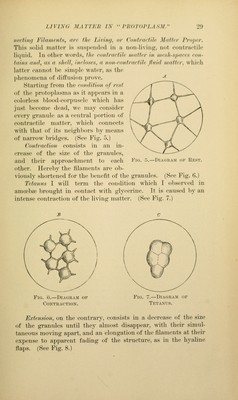
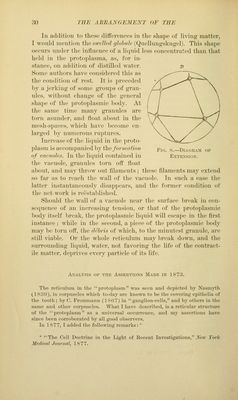
![Analysis of Rest. Lh-ing matter, as long: as it is alive, can never be at absolute rest, and in the protoplasm a uniform distribution of the reticulum is not observable as long as motion is present. The condition of comparative rest (Fig. 2) may be exhibited by a portion of the protoplasm ; while another portion is in the con- dition of contraction, another again is in that of extension. Rest is death, and seen in motionless blood or pus corpuscles, which on dying often assume the globular shape—viz., an accomplished equilibrium of the reticulum. By evaporation of the liquid, even such globular bodies may present a jagged, irregular shape, which is not amoeboid, as erroneously has been asserted, but the result of shrinkage. Death, however, may ensue at any moment during coutracti(jn or extension, if the li\'ing matter be killed instantaneously by a re-agent. Motionless pus-corpuscles—f. i., in urine—may be found in greatly varying amoeboid shapes, and the peculiarities of the reticulum in the contracted and extended condition remain fixed in such corpuscles if kept in ])reserving fluids—f. i., solution of chromic acid. Anah/sis of Contraction and Extension. Contraction of the reticulum causes the amoeboid motion and the locomotion of a protoplasmic mass. The liquid held in the meshes, being di-iven out of the contracted portion, will rush into a portion at the time at rest, and will extend this portion in the shape of what has been termed pseudopodia. If contraction takes place in one half of the protoplasmic mass, the other half will be in extension ; if two peripheral segments be contracted, the intermediate portion will be extended. The latter was suggested by Hermann, long before the structm-e of protoplasm was known. In the former instance a flap SiTll protrude, nearly of the diameter of the body itself; in the latter a narrow offshoot, a ^' pseudopodium,'' will make its appearance, var\dng in length, and exhibiting either an indistinct structure or being apparently devoid of structure, on account of the great sti-etching of the reticulum. To allow loco- motion to be accomplished, the protruded flap must adhere to a solid base, so as to have a point of fixation, toward which the balance of the T)ody is dragged. An amoeba, a colorless l)lood- corpuscle, can commence creeping only after one of the protruded flaps has reached the upper surface of the slide or the lower surface of the covering-glass, for the same reason that a man can make a step only on a solid ground, and climl> only by attaching himself with arms or legs to a support. The motion of protoplasmic lumps is liveliest if the slide and cover be close](https://iiif.wellcomecollection.org/image/b21219163_0060.jp2/full/800%2C/0/default.jpg)