Microscopical morphology of the animal body in health and disease / by C. Heitzmann. With 380 original engravings.
- Carl Heitzmann
- Date:
- 1883
Licence: Public Domain Mark
Credit: Microscopical morphology of the animal body in health and disease / by C. Heitzmann. With 380 original engravings. Source: Wellcome Collection.
Provider: This material has been provided by the Augustus C. Long Health Sciences Library at Columbia University and Columbia University Libraries/Information Services, through the Medical Heritage Library. The original may be consulted at the the Augustus C. Long Health Sciences Library at Columbia University and Columbia University.
73/884 page 47
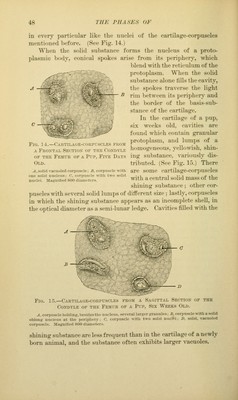
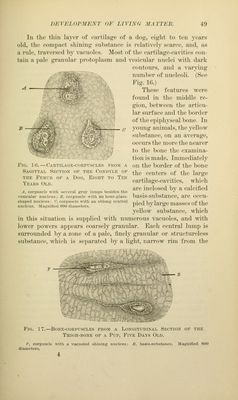
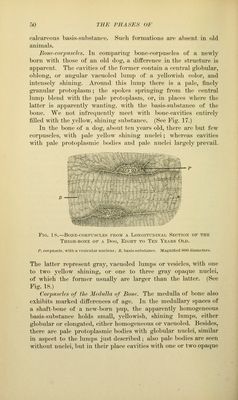
![either scattered tliroujjch the hody of the ani<jL'))a, or accumulated in f,n-()ui>s, hut litth' exceedingly in size that of the nucleus. Both kinds of <;raiiules are connected, l)y UK'ans of delicate filaments, with the reticulum of the living matter of the lump. The pale ^•ay uuclei of sucli older amoeba? always exhibit vacuoles. If we add a drop of f>-lycerine, diluted with one-half water, to a specinuMi containinji; am(e})a' of early formation, each amfje])a will, the moment it is reached by the glycerine, suddenly contract into a homo^-eneous, yellowish, very shining lump, the size of which is only a small fraction of its former circumference, or the amoeba shrivels to a scolloped lump, which by the bursting of peripheral vacuoles becomes in a few seconds nearly homo- geneous. Such lumps remain, as a rule, unchanged. Ama^l)a^ of a later period do not react uniformly to glycerine. If both a finely and coarsely granular amoeba should be present in the field of vision, the latter, on addition of glycerine, will rapidly be transformed into a homogeneous lump, while the former will slowly shrivel, sometimes only become corrugated on its surface, and retain its finely granular character, becom- ing, however, motionless and globular. Most of the lumps, sprung from coarsely granular amoebcP, enter the globular con- dition slowly. Some even remain unchanged. Whether this difference is due to difference of concentration of the glycerine which reaches different amoebse, even in one field of vision, I am unable to decide. By draining off the glycerine and replacing it with water, all lumps are gi-aduaLly transformed into globules, but none of them recover mobility. The series of changes which the coarse granules of the blood- corpuscles of craw-fish undergo, without the addition of any re- agent, are described in Chapter II., page 23. An originally solid, homogeneous lump of living matter, in a short time, under our very eyes, becomes at first vacuoled, and at length transformed into a delicate reticulum. Cartilage-corpuscles. In comparing the corpuscles of cartilage of mammals (I have examined the cartilage of the knee-joints of dogs, cats, and rabbits) of different age, marked differences are observed, dependent on the age of the animal. The cartilage cavities of a pup, five days old, hold proto- plasmic bodies, the nuclei of which are homogeneous, yellowish, and very shining, and sometimes contain vacuoles. Besides, there are mmierous smaller cavities entirely filled with a mass,](https://iiif.wellcomecollection.org/image/b21219163_0073.jp2/full/800%2C/0/default.jpg)