Microscopical morphology of the animal body in health and disease / by C. Heitzmann. With 380 original engravings.
- Carl Heitzmann
- Date:
- 1883
Licence: Public Domain Mark
Credit: Microscopical morphology of the animal body in health and disease / by C. Heitzmann. With 380 original engravings. Source: Wellcome Collection.
Provider: This material has been provided by the Augustus C. Long Health Sciences Library at Columbia University and Columbia University Libraries/Information Services, through the Medical Heritage Library. The original may be consulted at the the Augustus C. Long Health Sciences Library at Columbia University and Columbia University.
89/884 page 63
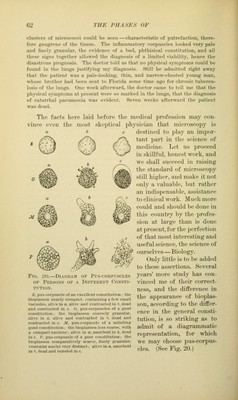
![Wln'iu'vt'r we inoi't witli |)us-cor|nisclrs in a spofimoii of iiriiic or sjnita, or, for iiistiiiicc, with colorless Itlood-corpiisclcs in a dro]) of blood, wliieh exhibit the features liere illustriitcd in a uniform ninniicr, tlu conclusion as to the general constitution of the individual can be made with certainty. Tlu^ exclusive presence of ])us-corpusclcs of the series P is a suie siii'u of a so-called '' tuberculous or phthisical constitution. Should jms or l)lo()d corpuscles of the series E be mixed with those of the series (i and .1/, this means that an ori<,nnally excel- lent constitution has become lowered l)y disease—the more so the greater the numlx'r of the corpuscles like those of the series P. Persons of a modei-ately ^ood constitution, broken down by chronic ailments, or by circumstances not favorable to their nutrition, <i:radually exhil)it, mixed with corpuscles of the series il/, those of the series I*. The presence of the series I* admits of longevity rarely, and only under the most favorable external Ciuiditions; the more the formations r of the series /' prevail, the surer it is that the death of the individual is approaching. Many other conclusions as to the significance of the amount of bioplasson ])resent nnist l)e postponed, as they are not as yet suiTticiently proved. Ol)viously, these may in the future lead to an important medical achievement in the prevention of disease. The features I have described as to the stages of develop- ment of living nuitter must l)e combined with the conclusions just stated, l)ecause the plastids of tissues—I am sure of those of bone and cartilage — exhibit, in all stages of development, differences due to differences in general constitution.](https://iiif.wellcomecollection.org/image/b21219163_0089.jp2/full/800%2C/0/default.jpg)