Microscopical morphology of the animal body in health and disease / by C. Heitzmann. With 380 original engravings.
- Carl Heitzmann
- Date:
- 1883
Licence: Public Domain Mark
Credit: Microscopical morphology of the animal body in health and disease / by C. Heitzmann. With 380 original engravings. Source: Wellcome Collection.
Provider: This material has been provided by the Augustus C. Long Health Sciences Library at Columbia University and Columbia University Libraries/Information Services, through the Medical Heritage Library. The original may be consulted at the the Augustus C. Long Health Sciences Library at Columbia University and Columbia University.
93/884 page 67
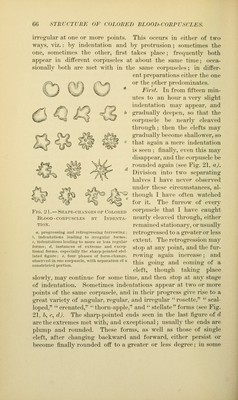
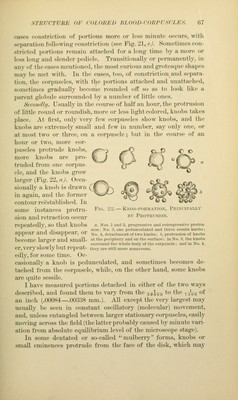
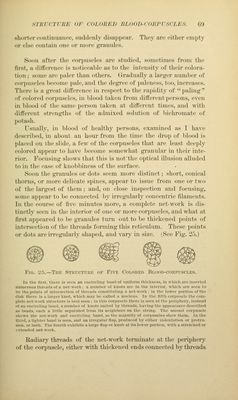
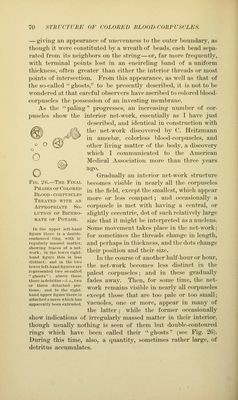
![STUrCTCliE OF COIJJJU'^JJ JllJJOJJ-COJa'l'SCJJ'JS. (u cases constriction of ])ortions more or loss inirmtc occurs, with scj)aration t(»llo\vin^^ cousti-iction (sec Fi<x. 21, cj. Sometimes con- stricted portions remain attached for a lon^ time 1)y a moi-e or less loufX and slender i)edicle. Trausitioiially or permanently, in any of the cases mentioned, the most curious and jL^otesque shapes maybe nu't with. In tlie cases, too, of constriction and separa- tion, the corpuscles, with the porti(ms attached and unattaclied, sometimes ^adually bec^ome rounded off so as to look like a ])arent ijlobule surrounded by a number of little ones. Sirondlii. Usually in tlie course of half an hour, the protrusion of little round or roundish, more or less light colored, knobs takes place. At first, only very few corpuscles show knobs, and the knobs are extremely small and few in number, say only one, or at most two or three, on a corpuscle; but in the course of an hour or two, more cor- puscles protrude knobs, more knobs are pro- truded from one corpus- cle, and the knobs grow larger (Fig. 22, (i). Occa- sionally a knob is drawn in again, and the former contour reestablished. In some instances protru- sion and retraction occur repeatedly, so that knobs a, Nos. l ami 2, progressive and retrogressive protru- ' -J 1. ^ siou ; No. 3, one pedunculated and three sessile knobs; appear and disappear, or j^^ 4, detachment of two knoljs; &, protrusion of knobs become larovr and small- ** t''*5 perlpliery and on tlie surface; in No. 3, the knobs '^ surround the whole body of the cori'uscle; and In No. 4, er, very slowly init repeat- tluy are still more numerous. edly, for some time. Oc- casionally a knol) is pedunculated, and sometimes becomes de- tached from the corpuscle, while, on the other hand, some knobs are qmte sessile. I have measured portions detached in either of the two w'a^'s described, and found them to vary fi-om the 3oooi> ^^ the - Jgo of an inch (.00084—.00338 mm.). All except the very largest may usually be seen in constant oscillatoiy (molecular) movement, and, unless entangled between larger stationary corpuscles, easily moving across the field (the latter probably caused by minute vari- ation from absolute equilibrium level of the microscope stage). In some dentated or so-caUed miilberry forms, knobs or small eminences protrude from the face of the disk, which may Fio. 22. -KXOB-FORMATIOX, PHIXCIPALLV BY Protrusion.](https://iiif.wellcomecollection.org/image/b21219163_0093.jp2/full/800%2C/0/default.jpg)