Protoplasm : its definition, chemistry and stucture / by Gustav Mann.
- Gustav Mann
- Date:
- 1906
Licence: In copyright
Credit: Protoplasm : its definition, chemistry and stucture / by Gustav Mann. Source: Wellcome Collection.
Provider: This material has been provided by The Royal College of Surgeons of England. The original may be consulted at The Royal College of Surgeons of England.
30/62 page 28
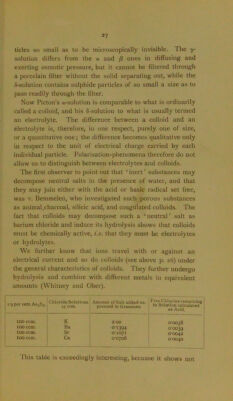
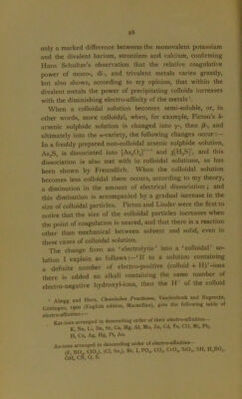
![only a marked difference betweeni the monovalent potassium and the divalent barium, strontium and calcium, confirming Hans Schultze's observation that the relative coagulative power of mono-, di-, and trivalent metals varies greatly, but also shows, according to my opinion, that within the divalent metals the power of precipitating colloids increases with the diminishing electro-affinity of the metals’. When a colloidal solution becomes semi-soluble, or, in other words, more colloidal, when, for example, Picton’s 8- arsenic sulphide solution is changed into y-, then ft-, and ultimately into the a-variety, the following changes occur In a freshly prepared non-colloidal arsenic sulphide solution, AsoS, is dissociated into [As203]°°° and 3[H2S]', and this dissociation is also met with in colloidal solutions, as has been shown by Freundlich. When the colloidal solution becomes less colloidal there occurs, according to my theory, a diminution in the amount of electrical dissociation ; and this diminution is accompanied by a gradual increase in the size of colloidal particles. Picton and Linder were the first to notice that the size of the colloidal particles increases when the point of coagulation is neared, and that there is a reaction other than mechanical between solvent and solid, even in these cases of colloidal solution. The change from an ‘ electrolytic ’ into a ‘ colloidal so- lution I explain as follows:—‘If to a solution containing a definite number of electro-positive (colloid + H)°-ions there is added an alkali containing the same number of electro-negative hydroxyl-ions, then the H of the colloid ’ Abegg and Herz, Chemisches Practicuin, Vandenhoek and Ruprecht, Gottingen, 1900 (English edition, Macmillan), give the following table of electro-affinities Kat-ions arranged in descending order of their electro-affinities- K, Na, Li, Ba, Sr, Ca, Mg, Al, Mn, Zn, Cd, Fe, CO, Mi, Pb, H, Cu, Ag, Hg, Pt, Au. An-ions arranged in descending order of electro-affinities— (F, NO3, CIO3), (Cl, So,), Br, I, POj, CO3, CrO„ S1O3, SH, H3BO3. OH, CN, O, S.](https://iiif.wellcomecollection.org/image/b22471303_0032.jp2/full/800%2C/0/default.jpg)
 No text description is available for this image
 No text description is available for this image
 No text description is available for this image