Typographia: or the printers' instructor, including an account of the origin of printing / [J. Johnson].
- John Johnson
- Date:
- 1824
Licence: Public Domain Mark
Credit: Typographia: or the printers' instructor, including an account of the origin of printing / [J. Johnson]. Source: Wellcome Collection.
670/708 (page 648)
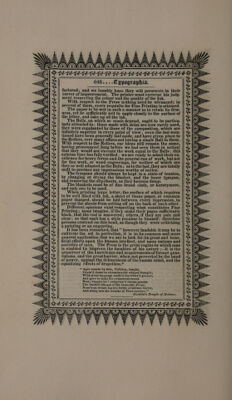
![Holl ce ae Se oe || ae Hh, ol | | h lh he Hi} it AN Atty, tel, ltl. ALA, AU, aU, AU tl ANE) A, ZZ ON EXENEN EN ENN ON ONEN ONE ON VB, factured; and we humbly hope they will persevere in their \p) = career of improvement. The printer must exercise his judg- am ment respecting the colour and the quality of the Ink. With respect to the Press nothing need be advanced; in several of them, every requisite for Fine Printing is attained. The paper to be wet in such a manner as to retain its firm- ness, yet be sufficiently soft to apply closely to the surface of the letter, and take up all the ink. f The Balls, on which so much depend, ought to be particu- larly attended to: those made with skins are now rarely used, they were supplanted by those of the composition, which are. infinitely superior in every point of view; even the last-men- tioned have been generally laid aside, and have given place to the Rollers, very many offices not having a single Ball in them. With respect to the Rollers, our ideas stil] remain the same, having pronounced (long before we had seen them in action) that they would not execute the work equal to the Balls: this opinion time has fully verified : we are ready to admit their ex- cellence for heavy forms and the general run of work, but not for fine work, or wood engravings, for neither of which are they so well adapted as the Balls ; as to the last ,they are totally unfit to produce any impressions worthy of notice. ‘ The tympans should always be kept in a state of tension, by changing or drying the blanket, and the inner tympan, and removing the slip-sheets, as they become damp. i IK hieai l i! | i| PT, JIGS Cy KS i The blankets must be of fine broad cloth, or kerseymere, and only one to be used. : When printing large letter, the surface of which requires : to be well filled with ink, a sheet of tissue paper, or common paper damped, should be laid between every impression, to prevent the sheets from setting off on the back of each other. Different opinions exist respecting what. constitutes Fine . Printing ; some imagine, if they make their pages sufficiently black, that the end is answered; others, if they are pale and . clear; so that each has a style peculiar to himself: therefore persons contend on this head, as though they were criticising a painting or an ener : It has been remarked, that ‘‘ however laudable it may be to | cultivate the art to perfection, it is to its common and more general application that we are to look for its great and bene- ficial effects upon the human intellect, and upon nations and societies of men. The Press is the great engine by which man is enabled to improve the faculties of his nature ;—it is the preserver of the knowledge and acquirements of former gene- ' rations, and the great barrier, when not peevere Oe the hand | of power, against the debasement of the human mind, and the ‘ equalizing effects of despotism.” | *« Ages remote by thee, Volition, tanght, Chain’d down in characters the winged thought; iit With silent language mark’d the letter’d ground, And gave to sight the evanescent sound. Now, happier lot ! enlighten’d realms possess ‘The learned labours of the immortal Press ; Nurs’d on whose lap the births of soience thrive, And rising arts the wrecks of Time survive.” Darwin's Temple of Nature. flint](https://iiif.wellcomecollection.org/image/b29350682_0670.jp2/full/800%2C/0/default.jpg)