Breeding and the Mendelian discovery / by A.D. Darbishire ... with illustrations in colour and black-and-white.
- Arthur Dukinfield Darbishire
- Date:
- 1911
Licence: Attribution-NonCommercial 4.0 International (CC BY-NC 4.0)
Credit: Breeding and the Mendelian discovery / by A.D. Darbishire ... with illustrations in colour and black-and-white. Source: Wellcome Collection.
193/370 page 121
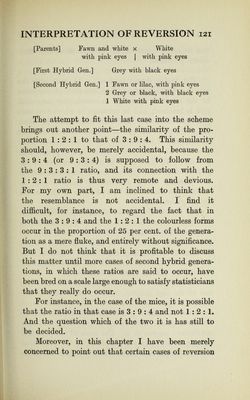
![INTERPRETATION OF REVERSION 121 [Parents] Fawn and white x White with pink eyes | with pink eyes [First Hybrid Gen.] Grey with black eyes [Second Hybrid Gen.] 1 Fawn or lilac, with pink eyes 2 Grey or black, with black eyes 1 White with pink eyes The attempt to fit this last case into the scheme brings out another point—the similarity of the pro¬ portion 1:2:1 to that of 3:9:4. This similarity should, however, be merely accidental, because the 3:9:4 (or 9:3:4) is supposed to follow from the 9:3:3:1 ratio, and its connection with the 1:2:1 ratio is thus very remote and devious. For my own part, I am inclined to think that the resemblance is not accidental. I find it difficult, for instance, to regard the fact that in both the 3:9:4 and the 1:2:1 the colourless forms occur in the proportion of 25 per cent, of the genera¬ tion as a mere fluke, and entirely without significance. But I do not think that it is profitable to discuss this matter until more cases of second hybrid genera¬ tions, in which these ratios are said to occur, have been bred on a scale large enough to satisfy statisticians that they really do occur. For instance, in the case of the mice, it is possible that the ratio in that case is 3 : 9 : 4 and not 1:2:1. And the question which of the two it is has still to be decided. Moreover, in this chapter I have been merely concerned to point out that certain cases of reversion](https://iiif.wellcomecollection.org/image/b18022819_0194.JP2/full/800%2C/0/default.jpg)