A new treatise on the use of the globes, or a philosophical view of the earth and heavens / [Thomas Keith].
- Thomas Keith
- Date:
- 1808
Licence: Public Domain Mark
Credit: A new treatise on the use of the globes, or a philosophical view of the earth and heavens / [Thomas Keith]. Source: Wellcome Collection.
28/398 (page 2)
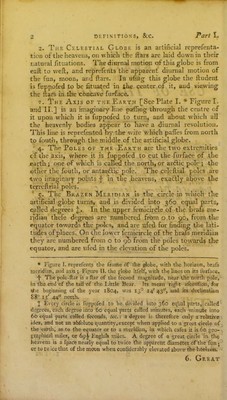
![2. The Celestial Globe is an artificial rcprefenta- tion of the heavens, on which the Itars arc laid down in their natural fituations. The diurnal motion of tliis globe is from call to weft, and reprefents the apparent diurnal motion of the fun, moon, and ftars. In ufmg this globe the ftudent is fuppofed to be fituated in the center of it, and viewing the ftars in the concave furface. The Ax;s of the Earth See Plate I. * Figure I. and II.] is an imaginary line pafTHig through the centre of it upon which it is fuppofed to turn, and about which all the heavenly bodies appear to have a diurnal revolution. This line is reprefented by the wire which paftes from north to fouth, through the middle of the artificial globe. ■ 4. The Poles of the Earth are the two extremities cf the axis, where it is fuppofed to cut the furface of the earth ; one of which is called the north, or arclic pole ; the otlier the fouth, or antar£lu; pole. The celeftial poles are two imaginary pofiits f in th^ .heavens, exactly above the terreftrial poles. 5. The Brazen Meridian is the circle in ivhich the artificial globe turns, and is divided into 360 equal parts, called degrees J. In the upper femicirde of the brais me- rjdiau thefe degrees are numbered from o to 90, from the equator towards the poles, and are ufed for finding the lati- tudes of places. On the lower femicirde of the brafs meridian they are numbered from o to 90 from the poles towards the equator, and are uled in the elevation of the poles. * Figure I. reprefents the frariie of the ^obc, with the horizon, brafs meridian, and axis ; Figure 11. the globe itfelf, witli the lines on its furface. •f Thepole-ftar is a liar of the fecond magnitude, near the north pole, in the end of the tail of the I.ittle Bear. Its mean rigi t afcenfion, for tf\e beginning of the year 1804, w.as 13'^ 14'43, and its declination 88 15' 44 north. Every circle is fuppofed to he divided into 360 eqhal parts, called degrees, each degree into 60 equal parts called minutes, each -minute into 60 equal parts celled feconds, &c.: a degree is therefore only a relative idea, and not an abfolutc quantity,exccpt when applied to a great circle of the earth, as to the equator or to a meridian, in which cafes it is 60 gco- grapliical miles, or 6^^ F.nglifh miles. A degree of a great circle in tire heavens is a fpace nearly equal to twice the apparent diamdter of the fun; or to twice that of the moon when confidcrably elevated above the horizon. 6. Great](https://iiif.wellcomecollection.org/image/b22028420_0028.jp2/full/800%2C/0/default.jpg)