A manual of physics, theoretical and practical : for medical students / by Hugh C. H. Candy.
- Candy, Hugh Charles Herbert, 1859-1935
- Date:
- 1918
Licence: In copyright
Credit: A manual of physics, theoretical and practical : for medical students / by Hugh C. H. Candy. Source: Wellcome Collection.
222/470 (page 208)
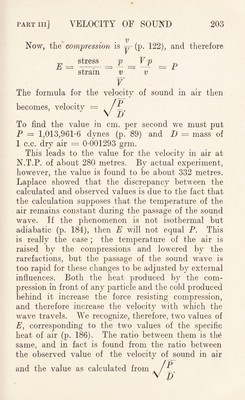
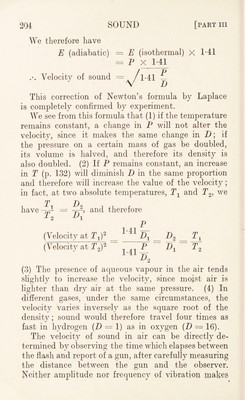
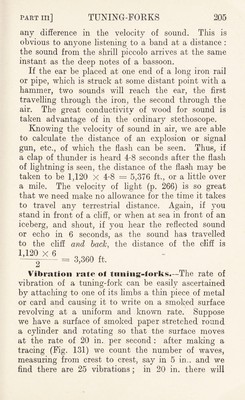
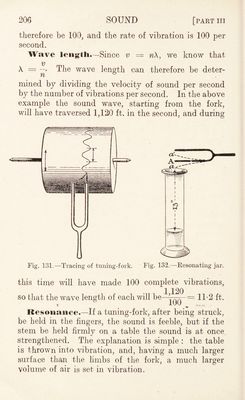
![might be found corresponding to these values of d. They are all nodal planes and are separated by The open end is an antinode. This furnishes a simple method of finding the wave length of a note by multiplying the shortest resonating length by 4 ; by dividing this into the velocity of sound in air we obtain the frequency. If the tube is long enough to give two nodes at distances d-^ and we can find X from the fact that d^ — d^= 2 If we can find only the first node, a small correction is usually made for the open end. The corrected length may be taken to be c? — > where r is the radius of the tube. Rang:e of audibility. —The extreme range of audibility appears to differ in individual cases. Tyndall quotes instances in proof of this. This perhaps accounts for the difference in the estimates by different observers of the limits of hearing. It seems probable from the experiments of Helmholtz that the lower limit corresponds pretty nearly to the value w = 30 ; while the higher limit seems to be in the neighbourhood oi n — 24,000. This gives a range of nearly ten octaves. In practice the usual musical range is approximately from 32 to 4,000, or about seven octaves. The O', the middle C of a soprano, is about 512. In the time of Handel it was 507. The C' on the Albert Hall organ is 541, so that our B is about the same pitch as HandeTs C. ]\oise, strictly speaking, is any audible sound, whether musical or not ; the musical sound results from regular and rhythmical vibrations, a definite number of impulses striking the ear at regular](https://iiif.wellcomecollection.org/image/b29927973_0222.jp2/full/800%2C/0/default.jpg)