A manual of physics, theoretical and practical : for medical students / by Hugh C. H. Candy.
- Candy, Hugh Charles Herbert, 1859-1935
- Date:
- 1918
Licence: In copyright
Credit: A manual of physics, theoretical and practical : for medical students / by Hugh C. H. Candy. Source: Wellcome Collection.
44/470 (page 30)
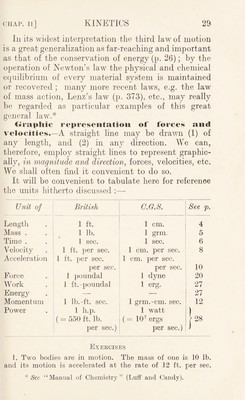
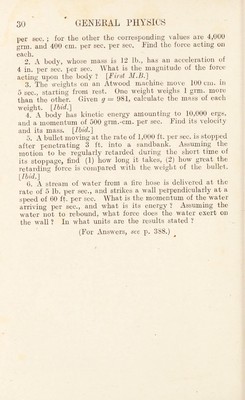
![per sec.; for the other the corresponding values are 4,000 grni. and 400 cm. per sec. per sec. Find the force acting on each. 2. A body, whose mass is 12 lb., has an acceleration of 4 in. per sec. per sec. What is the magnitude of the force acting upon the body ? [First M.B.^ 3. The weights on an Atwood machine move 100 cm. in 5 sec., starting from rest. One weight weighs 1 grm. more than the other. Given g~ 981, calculate the mass of each weight. [lhid.'\ 4. A body has kinetic energy amounting to 10,000 ergs, and a momentum of 500 grm.-cm. per sec. Find its velocity and its mass. [IhidV] 5. A. bullet moving at the rate of 1,000 ft. per sec. is stopped after penetrating 3 ft. into a sandbank. Assuming the motion to be regularly retarded during the short time of its stoppage, find (1) how long it takes, (2) how great the retarding force is compared with the weight of the bullet. (3. A stream of water from a lire hose is delivered at the rate of 5 lb. per sec., and strikes a wall perpendicularly at a speed of 60 ft. per sec. What is the momentum of the water arriving per sec., and what is its energy ? Assuming the water not to rebound, what force does the water exert on the wall ? In what units are the results stated ? (For Answers, see p. 388.)](https://iiif.wellcomecollection.org/image/b29927973_0044.jp2/full/800%2C/0/default.jpg)