A manual of physics, theoretical and practical : for medical students / by Hugh C. H. Candy.
- Candy, Hugh Charles Herbert, 1859-1935
- Date:
- 1918
Licence: In copyright
Credit: A manual of physics, theoretical and practical : for medical students / by Hugh C. H. Candy. Source: Wellcome Collection.
54/470 (page 40)
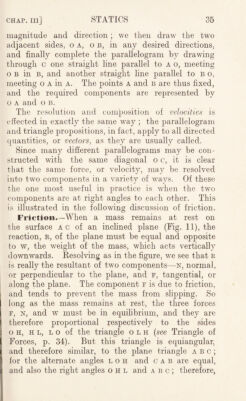
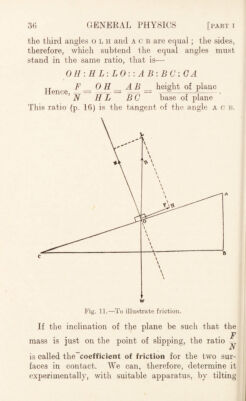
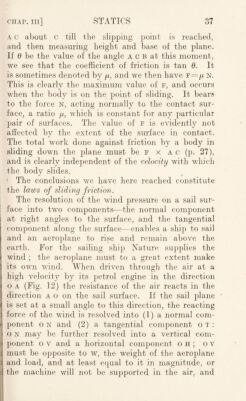
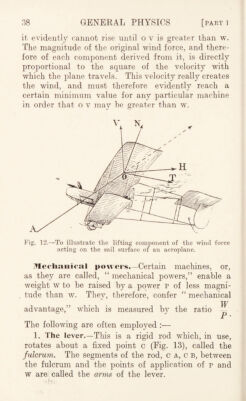
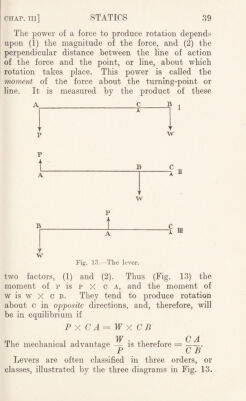
![Tlie co]imion balance is an example of Class i. The arms are of equal length in the pair of scales, but in the “ steelyard ” type a constant force p is ap¬ plied at different points on c A to balance different values of w. In the beam and scales we can find the true weight of P, even if the arms are not equal, by placing it first in one scale and then in the other. Suppose that it is balanced in the first case by IPj, and in the second by W2 we loiow then that Px CA = ifix an and Px CB^W^X CA Therefore, by multiplication, P- = IFi X W2 and P = Clfi X H', We can also find the true Aveight of P with a false balance of this type by the method of counterpoise or substitution. Place P in one pan and counterpoise it with sand, etc., in the other pan; then remove P and substitute AA^eights sufficient to balance the un¬ disturbed counterpoise. The sum of these Aveights is the true AA^eight of P. A pair of nut-crackers, or a lemon-squeezer, is an example of Class ii. The hinge is at c, the nut or lemon at b, and the pressure of the hand is applied at a. The human forearm, Avhen raising a Aveight sup¬ ported on the palm of the hand, is an example of Class III. The fulcrum c is at the elboAv, Avhere the ulna articulates AAutli the humerus; the power is applied by the biceps muscle at its point of attach¬ ment betAveen the elbow and hand. 2. The wheel and axle (Fig. 14).—When this machine is worked, a, the point of application of p, describes the circumference of a circle AA^'hose radius](https://iiif.wellcomecollection.org/image/b29927973_0054.jp2/full/800%2C/0/default.jpg)