Eleven cases : roentgenographic and operative findings / by A. Judson Quimby and William Seaman Bainbridge.
- Quimby, A. Judson (Adoniram Judson), 1875-
- Date:
- 1914
Licence: In copyright
Credit: Eleven cases : roentgenographic and operative findings / by A. Judson Quimby and William Seaman Bainbridge. Source: Wellcome Collection.
Provider: This material has been provided by The Royal College of Surgeons of England. The original may be consulted at The Royal College of Surgeons of England.
10/34 page 8
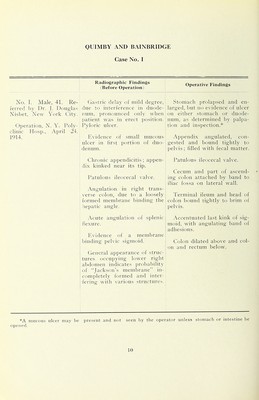
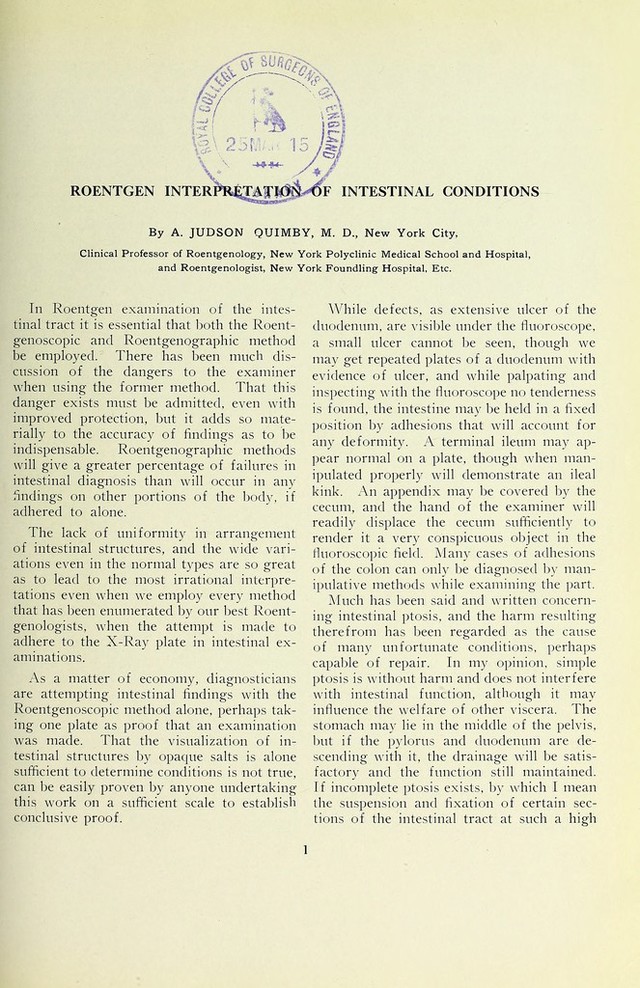
![which I shall presently show, will demon- strate. According to Jordan, “the general disease at the l)ottoin of the case can al- ways Ije revealed by a complete radiological investigation of the alimentary system,” and it is just this contention which, it seems to me, should stimulate radiologists to make careful and painstaking investigations along the lines laid down by Lane and Jordan. In this connection I wish to emphasize the importance of the fluoroscopic examina- tion in all cases. “X-ray diagnosis after a l)ismuth meal,” according to Jordan, “de- pends entirely upon observations with the fluorescent screen. It is all-important to watch the movements accomi)an_ving respira- tion, the peristaltic activities of the different parts, and to ascertain the ])resence of fixed parts (e. g., in the terminal ileum), and of thickened ]>arts (terminal ileum, appendix, iliac colon, etc.) by direct manipulation un- der the fluorescent screen. The patient must, therefore, he as accessible to the observer as he would l)e to the surgeon al)Out to op- erate upon him. In commencing the in- vestigation,” he continues, “we gain an im- portant clue at the first e.xamination when we observe the duodenum. This is without (loul)t, the most sensitive part of the ali- nienary tract; even the early stages of in- testinal stasis produce their inevitable effect upon the duodenum which liecomes dis- tended from obstruction (by kinking) at the commencement of the jejunum. The difficulty this kink causes the duodenum is obvious when the duodenum is observed (by the fluorescent screen) full of Insmuth emulsion. In the first place the duodenum is obviously enlarged; its vertical portion measures 4 to 5 inches instead of to iiiches as in normal cases. The width of the duodenum is often double that of the normal, the first part of the duodenum I)e- ing especially dilated. More remarkal)le by far than the increased size is the altered Itehavior of the ‘static’ dnodenum. It is ex- ceedingly active, strong waves following- one another along the four parts of the duodemnu, and thrusting the contents l)e- fore them. The strong waves are not ef- fective. however: the contents get no far- ther than the third or fourth part of the duodenum; and as the wave passes off' the whole of the contents flow l)ack rapidly to the second (vertical) part. This event is often seen to recur over and over again, and for ten minutes or more no bismuth will enter the jejunum; then perhaps a per- istaltic wave will come more powerful than any, and a full measure of bismuth fluid will enter the jejunum, the kink having been overcome for the moment. So powerful are the efforts of the ‘static’ duodenum that the entire organ gets distorted into various forms, giving the appearance of ‘writhing.’ ” Thus, Jordan says, “The radiologist can demonstrate not only the end result (such as a gastric or duodenal ulcer ), but also the various manifestations dne to statis itself. They should make any surgeon think twice before he decides to l:)e content with the old order of things.” I have quoted these statements from Jor- dan. who has had a wider experience, having worked with Lane for so long, than perhaps any other radiologist has hatl in the study of the particular conditions under discus- sion, I)ecause I wish, in so far as I am able, to encourage this kind of work. I have fre- quently noted the tendency of the X-ray worker to l)ecome discouraged after a few fruitless attempts at diagnosticating condi- tions involving the alimentary tract. The wonderful success which Jordan and those who have persisted have attained should en- courage others to renewed determination. In this connection I wish to express my sincere appreciation of the careful and painstaking work which Dr. Ouimlw, Dr. Cole, and others, have been doing in this direction. I have purposely selected for presentation on this occasion cases in each of which Dr. Ouimlw has made the fluoro- sco[)ic and radiographic examinations. He has presented the radiographic phase of these ca.ses, showing the findings before op- eration, as revealed by fluoroscopic and X- rav examinations. Bv reference to his find-](https://iiif.wellcomecollection.org/image/b22463860_0012.jp2/full/800%2C/0/default.jpg)