Eleven cases : roentgenographic and operative findings / by A. Judson Quimby and William Seaman Bainbridge.
- Quimby, A. Judson (Adoniram Judson), 1875-
- Date:
- 1914
Licence: In copyright
Credit: Eleven cases : roentgenographic and operative findings / by A. Judson Quimby and William Seaman Bainbridge. Source: Wellcome Collection.
Provider: This material has been provided by The Royal College of Surgeons of England. The original may be consulted at The Royal College of Surgeons of England.
7/34 page 5
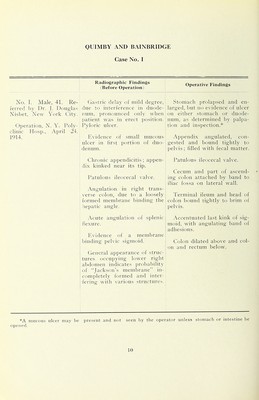
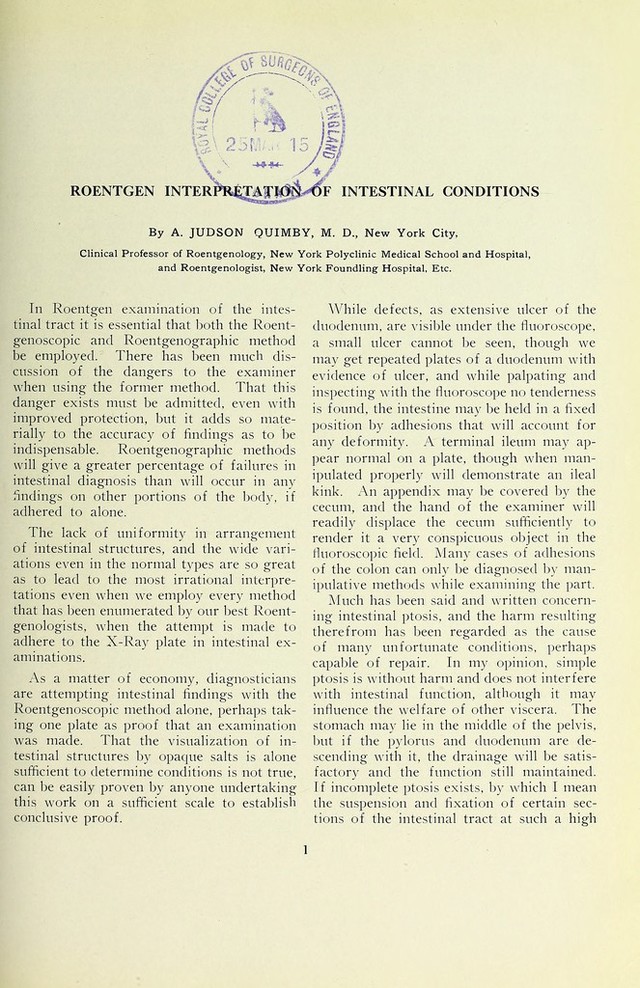
![forcing the cecum upward into the ab- domen. This has only Ijeen observed as an accident, occurring in the course of an ex- amination in three or four cases. The great omentum may be adherent in the lower abdomen or the pelvis, in such a way as to hold some section of the intes- tines securely in an abnormal position, and sc simulate adhesions of this special section of the gut, as to give us a wrong reading. One case examined by me, in which I re- ported probable adhesions binding the left transverse colon in the left iliac fossa, was found at operation to present a dense fibrous band extending from the left lateral abdominal wall downward and inward to the pelvic structures, making a pocket be- tween it and the posterior pelvic wall, in which the transverse colon was wedged and was only elevated after severing the bands. No adhesions of the transverse colon ex- isted. The so-called “J^ickson’s Membrane” and other evolutionary membranes and l)ands, and what I generally designate a contracted meso-colon, are liest found by manipulation in conjunction with the fluoroscope in the vertical and horizontal position. Mesen- teric bands and contracted mesentery have a predilection for forming at five places, which are: just above the cecum on the ascending colon; a short distance from the hepatic flexure; a few cm. below the splenic flexure; at the juncture of the descending colon with the ileal sigmoid; and at the juncture of the iliac and pelvic sigmoid. They may occur at other places, but the above-mentioned points are where they are most commonly found. Those just below the splenic flexure are frequently located by the patient taking a deep inhalation, which forces the splenic flexure downward, so that the drag is placed upon the fixed point. y\t other places they are l)est determined by mani]mlation. I am convinced that Nature has estab- lished certain compensatory phenomena that cf|ualize the material supplied the intestinal tract, and by that, tends to prohibit the re- ception of more material after a safe amount has been received, and that the quantity is dependent on the power of any special portion to digest the amount therein. I believe that pyloric spasm is partly due to a protest against more food entering the intestine after a given amount has pro- ceeded, and that a spastic state at any point, is an attempt to regulate the amount in- gested by the digestive system. Modification of this inhiljitory function occurs when ab- normalities develop, such as the intense spasmodic waves of peristalsis in the duo- denum and ileum, the occasional isolated contraction in the upper half of the colon, and the intense spastic state of the lower half of the colon, which is commonly seen accompanying abnormal appendices, ileal kinks, and various adhesions. Of the many cases I have examined, I have never had convincing evidence of re- versed peristalsis; certain phenomena do oc- cur following the administration of an enema, which may be looked upon as per- istalsis carrying the intestinal contents backward. Careful observation will quick- ly show us that this is not due to a con- striction of the colon below the material which is moving upward, but is simply a backward flow, passive in character, which occurs when expulsion is prohibited and the bowel relaxes above. I have seen two cases in which there was proof of the ascension of material that had been ingested. In one of these, the return had been from the lower colon to the cecum and in the other on the sixth day following the first bismuth meal, and after all was in the colon, there was a return as far as the duodenum. They were both cases of extreme atony, the en- tire organism being in a state of exhaustion. Should the colonic contents become very fluid as the result of downward flow of a large quantity of the ileac feces, it can readily be seen that the bismuth mass could l)e disintegrated sufficiently to drift upward, the same as witnessed following an enema.](https://iiif.wellcomecollection.org/image/b22463860_0009.jp2/full/800%2C/0/default.jpg)