Volume 1
A treatise on the science and practice of midwifery / by W.S. Playfair.
- William Smoult Playfair
- Date:
- 1898
Licence: Public Domain Mark
Credit: A treatise on the science and practice of midwifery / by W.S. Playfair. Source: Wellcome Collection.
121/488 (page 89)
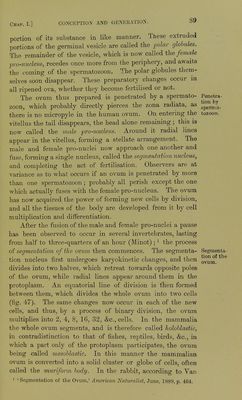
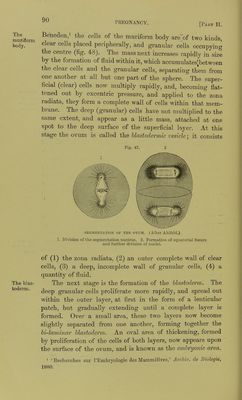
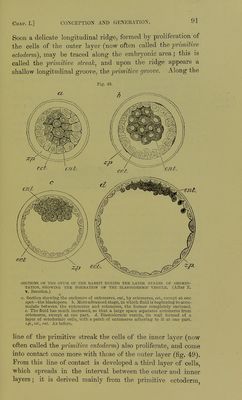
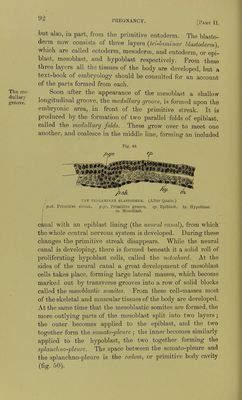
![Chap. I.] CONCEPTION AND OENEliATION. S9 portion of its substance in like manner. These extruded portions of the germinal vesicle are called the 2^olar globules. The remainder of the vesicle, which is now called the female p'o-nucleus^ recedes once more from the periphery, and awaits the coming of the spermatozoon. The polar globules them- selves soon disappear. These preparatory changes occur m all ripened ova, whether they become fertilised or not. The ovum thus prepared is penetrated by a spermato- Penetra- zoon, which probably directly pierces the zona radiata, as gp^^^^f^. there is no micropyle in the human ovum. On entering the tozoon. vitellus the tail disappears, the head alone remaining ; this is now called the male 'pro-nucleus. Around it radial lines appear in the vitellus, forming a stellate arrangement. The male and female pro-nuclei now approach one another and fuse, forming a single nucleus, called the segmerttation nucleus, and completing the act of fertilisation. Observers are at variance as to what occurs if an ovum is penetrated by more than one spermatozoon; probably all perish except the one which actually fuses with the female pro-nucleus. The ovum has now acquired the power of forming new cells by division, and all the tissues of the body are developed from it by cell multiplication and differentiation. After the fusion of the male and female pro-nuclei a pause has been observed to occur in several invertebrates, lasting from half to three-quarters of an hour (Minot) ; ^ the process of segmentation of the ovum then commences. The segmenta- Segmenta- tion nucleus first undergoes karyokinetic changes, and then ^y^^^^ divides into two halves, which retreat towards opposite poles of the ovum, while radial lines appear around them in the protoplasm. An equatorial line of division is then formed between them, which divides the whole ovum into two cells (fig. 47). The same changes now occur in each of the new cells, and thus, by a process of binary division, the ovum multiplies into 2, 4, 8, 16, 32, &c., cells. In the mammalia the whole ovum segments, and is therefore called holohlastic, in contradistinction to that of fishes, reptiles, birds, &c., in which a part only of the protoplasm paiticipates, the ovum being called onesohlastie. In this manner the mammalian ovum is converted into a solid cluster or globe of cells, often called the muriform hody. In the rabbit, according to Van ' ' Segmentation of the Ovum,' American Naturalist, June, 1889, p. 464.](https://iiif.wellcomecollection.org/image/b20414274_001_0123.jp2/full/800%2C/0/default.jpg)