Volume 1
A treatise on the science and practice of midwifery / by W.S. Playfair.
- William Smoult Playfair
- Date:
- 1898
Licence: Public Domain Mark
Credit: A treatise on the science and practice of midwifery / by W.S. Playfair. Source: Wellcome Collection.
74/488 (page 46)
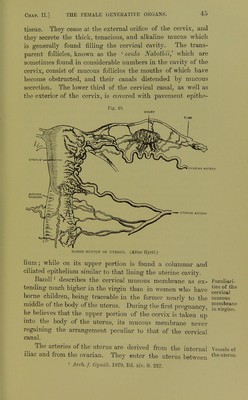
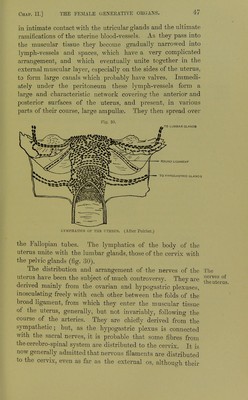
![the folds of the broad ligaments (fig. 29), and, penetrating its muscular coat, anastomose freely with each other and with the corresponding vessels of the opposite side. They are described by Williams' as entering the uterus on its sides and then running a somewhat superficial course, being separated from the peritoneum by a thin layer of muscular fibres. They are here placed in a distinct layer of connective tissue, and give off branches which pass perpendicularly towards the uterine canal. Their walls are thick and well developed, and they are remarkable for their very tortuous course, forming spiral curves, especially in the upper part of the uterus. They end in minute capillaries which form the fine meshes surrounding the glands, and in the cervix give ofi* the loops entering the papillas. Beneath the uterine mucous membrane these capillai^ies form a plexus, terminating in veins without valves, which unite with each other to form the large veins traversing the substance of the uterus, known during pregnancy as the uterine sinuses, the walls of which are closely adherent to the uterine tissues. These veins run a similar course to the arteries, and end in a venous plexus lying in the layer of connective tissue already mentioned, which Williams believes to be the true sub-mucous tissue of the uterus, the thick layer of muscular tissue between it and the uterine cavity being really ' muscularis mucosaa.' In consequence of this arrangement the circulation of the uterus can hardly be disturbed by mechanical causes. The veins, freely anastomosing with each other, pass from the uterus to the folds of the broad ligaments, where they unite to form, with the ovarian and vaginal veins, a large and well-developed venous network, known as the immpiniform ]plexus. The lym- The lymphatics of the uterus are large and well developed, phatics of and they play an important part in the production of certain puerperal diseases. A more minute knowledge than we at present possess of their course and distribution will pro- bably throw much light on their influence in this respect. According to the researches of Leopold,^ who has studied their minute anatomy carefully, they originate in lymph spaces between the fine bundles of connective tissue forming the basis of the mucous lining of the uterus. Here they are ' Trans. Obst. Society, 1885, vol. xxvii. p. 112. - Arch.f. Gyncik. 1873, Bd. vi. Heft 1, S. 1.](https://iiif.wellcomecollection.org/image/b20414274_001_0076.jp2/full/800%2C/0/default.jpg)