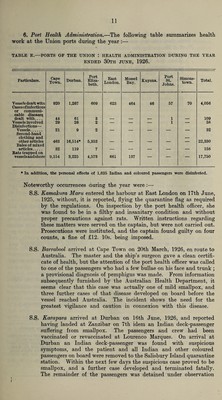
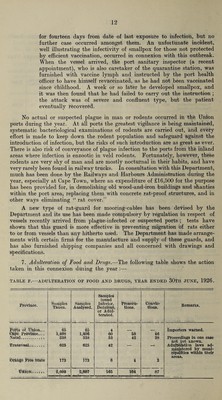
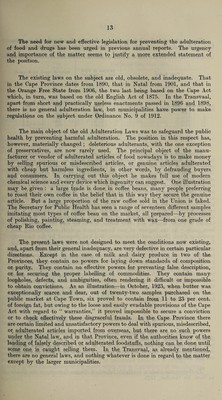
Annual report of the Department of Public Health / Union of South Africa.
- South Africa. Department of Health
- Date:
- [1926]
Licence: Public Domain Mark
Credit: Annual report of the Department of Public Health / Union of South Africa. Source: Wellcome Collection.
16/74 (page 14)
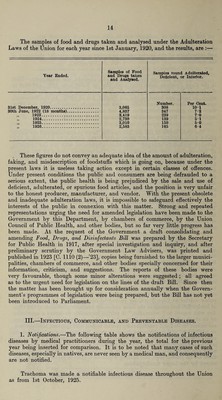
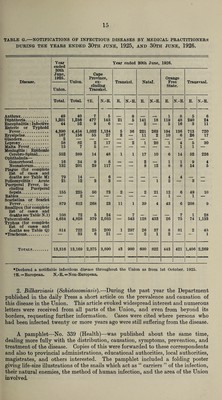
![The samples of food and drugs taken and analysed under the Adulteration Laws of the Union for each year since 1st January, 1920, and the results, are :— Year Ended. Samples of Food and Drugs taken and Analysed. Samples found Adulterated, Deficient, or Inferior. 31st December, 1920. 3,065 Number. 308 Per Cent. 10-1 30th June, 1922 (18 months). 4,837 347 7-2 1923. 3,419 239 70 1924... 2,730 139 51 „ 1925. 3,010 150 50 1926. 2,583 165 6 4 These figures do not convey an adequate idea of the amount of adulteration, faking, and misdescription of foodstuffs which is going on, because under the present laws it is useless taking action except in certain classes of offences. Under present conditions the public and consumers are being defrauded to a serious extent, the public health is being prejudiced by the sale and use of deficient, adulterated, or spurious food articles, and the position is very unfair to the honest producer, manufacturer, and vendor. With the present obsolete and inadequate adulteration laws, it is impossible to safeguard effectively the interests of the public in connexion with this matter. Strong and repeated representations urging the need for amended legislation have been made to the Government by this Department, by chambers of commerce, by the Union Council of Public Health, and other bodies, but so far very little progress has been made. At the request of the Government a draft consolidating and amending Food, Drugs, and Disinfectants Bill was prepared by the Secretary for Public Health in 1917, after special investigation and inquiry, and after preliminary scrutiny by the Government Law Advisers, was printed and published in 1923 [C. 1110 (2)—’23], copies being furnished to the larger munici¬ palities, chambers of commerce, and other bodies specially concerned for their information, criticism, and suggestions. The reports of these bodies were very favourable, though some minor alterations were suggested ; all agreed as to the urgent need for legislation on the lines of the draft Bill. Since then the matter has been brought up for consideration annually when the Govern¬ ment’s programmes of legislation were being prepared, but the Bill has not yet been introduced to Parliament. III.—Infectious, Communicable, and Preventable Diseases. 1. Notifications.—The following table shows the notifications of infectious diseases by medical practitioners during the year, the total for the previous year being inserted for comparison. It is to be noted that many cases of such diseases, especially in natives, are never seen by a medical man, and consequently are not notified. Trachoma was made a notifiable infectious disease throughout the Union as from 1st October, 1925.](https://iiif.wellcomecollection.org/image/b31477070_0016.jp2/full/800%2C/0/default.jpg)