Theories of population from Raleigh to Arthur Young : lectures delivered in the Galtonian laboratory, University of London, under the Newmarch foundation, February 11 to March 18, 1929, with two additional lectures and with references to authorities, / by James Bonar.
- James Bonar
- Date:
- 1931
Licence: In copyright
Credit: Theories of population from Raleigh to Arthur Young : lectures delivered in the Galtonian laboratory, University of London, under the Newmarch foundation, February 11 to March 18, 1929, with two additional lectures and with references to authorities, / by James Bonar. Source: Wellcome Collection.
237/264 page 233
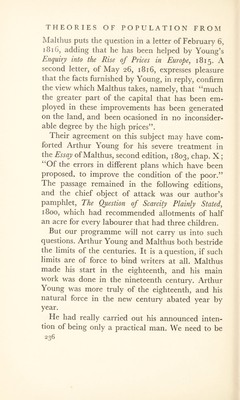
![principles for the national conduct from a mere supposition of population was a doctrine tending to very mischievous errors. I therefore was con¬ vinced that an actual enumeration of the people ought to take place.”24 He would not himself have counted this Proposal his highest flight. He seems prouder to have been the introducer of chicory into England; to have done that was not to have lived in vain. His favourite among his books was that on Wastes, Inquiry into the Propriety of applying Wastes to the better Maintenance of the Poor. This is not the Observations on the Present State of the Wastelands in this Kingdom, 1772. The Inquiry appeared thirty years afterwards, namely, in 1801, and is discussed by Mai thus in his Essay at the end of a long criticism of Arthur Young’s schemes of reform. “The Plough”,25 as he said, was always before him; it is much better to make experiments than to write books. So at Milan, October 6, 17^9: “This day has passed after my own heart, a long morning, active, and then dinner, without one word of conversation but on agriculture.” “If they [the Abbeys] contained the register of their ploughs, they would have been interesting; but what to me are the records of gifts to convents, for saving souls that wanted probably too much cleaning for all the scrubbing-brushes of the monks to brighten!” He could enjoy Leonardo and Cimarosa and admired Lawrence Sterne. But his heart was in Agriculture.](https://iiif.wellcomecollection.org/image/b29931782_0237.jp2/full/800%2C/0/default.jpg)