Theories of population from Raleigh to Arthur Young : lectures delivered in the Galtonian laboratory, University of London, under the Newmarch foundation, February 11 to March 18, 1929, with two additional lectures and with references to authorities, / by James Bonar.
- James Bonar
- Date:
- 1931
Licence: In copyright
Credit: Theories of population from Raleigh to Arthur Young : lectures delivered in the Galtonian laboratory, University of London, under the Newmarch foundation, February 11 to March 18, 1929, with two additional lectures and with references to authorities, / by James Bonar. Source: Wellcome Collection.
28/264 page 24
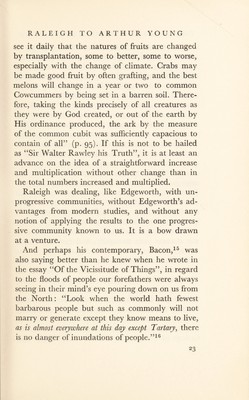
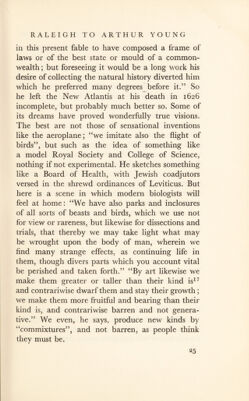
![This very essay contains the famous passage, so characteristic of those times, so paradoxical, if not meaningless, in ours: “In the youth of a state, arms do flourish; in the middle age of a state, learning; and then both together. In the declining age of a state, mechanical arts and merchandise.” In the essay on “Seditions and Troubles” he advises against multiplying the nobility and the clergy and scholars; it is the yeomen that are the best to fight our battles, and we must preserve them and set aside land for them,—as he observed was done under Henry VII. Otherwise enclosures cause a dangerous dearth of people. “Better a greater number that live lower and gather more.” In the essay on “The True Greatness of Kingdoms and Estates” he says we do not want “great population and little strength”. We should always be in a condition to fight; and in fact foreign wars do us good; they are not a curse but a blessing (ibidem). He was not a political reformer; he seems to rest content with monarchy, and even a military monarchy. He made much of Naval power. But his ideals lay elsewhere than in politics. His “New Atlantis” was not a social Utopia like Sir Thomas More’s (1518). “This fable [says his editor] my lord devised to the end that he might exhibit therein a model or description of a college instituted for the interpreting of nature and the producing of great and marvellous works for the benefit of man under the name of Solomon’s House or the College of the Six Days5 Work. He thought also](https://iiif.wellcomecollection.org/image/b29931782_0028.jp2/full/800%2C/0/default.jpg)