Theories of population from Raleigh to Arthur Young : lectures delivered in the Galtonian laboratory, University of London, under the Newmarch foundation, February 11 to March 18, 1929, with two additional lectures and with references to authorities, / by James Bonar.
- James Bonar
- Date:
- 1931
Licence: In copyright
Credit: Theories of population from Raleigh to Arthur Young : lectures delivered in the Galtonian laboratory, University of London, under the Newmarch foundation, February 11 to March 18, 1929, with two additional lectures and with references to authorities, / by James Bonar. Source: Wellcome Collection.
38/264 page 34
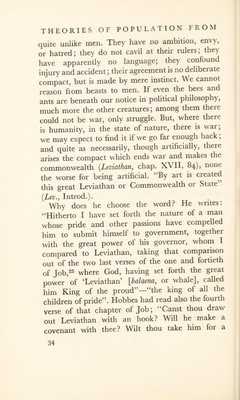
![quite unlike men. They have no ambition, envy, or hatred; they do not cavil at their rulers; they have apparently no language; they confound injury and accident; their agreement is no deliberate compact, but is made by mere instinct. We cannot reason from beasts to men. If even the bees and ants are beneath our notice in political philosophy, much more the other creatures; among them there could not be war, only struggle. But, where there is humanity, in the state of nature, there is war; we may expect to find it if we go far enough back; and quite as necessarily, though artificially, there arises the compact which ends war and makes the commonwealth (.Leviathan, chap. XVII, 84), none the worse for being artificial. “By art is created this great Leviathan or Commonwealth or State” (Lev., Introd.). Why does he choose the word? He writes. “Hitherto I have set forth the nature of a man whose pride and other passions have compelled him to submit himself to government, together with the great power of his governor, whom I compared to Leviathan, taking that comparison out of the two last verses of the one and fortieth of Job,23 where God, having set forth the great power 5of ‘Leviathan’ [balaena, or whale], called him King of the proud”—“the king of all the children of pride”. Hobbes had read also the fouith verse of that chapter of Job; “Canst thou draw out Leviathan with an hook? Will he make a covenant with thee? Wilt thou take him for a](https://iiif.wellcomecollection.org/image/b29931782_0038.jp2/full/800%2C/0/default.jpg)