Food and its adulterations : comprising the reports of the Analytical sanitary commission of "The Lancet" for the years 1851 to 1854 inclusive, revised and extended being records of the results of some thousands of original microscopical and chemical analyses of the solids and fluids consumed by all classes of the public ... / by Arthur Hill Hassall.
- Arthur Hill Hassall
- Date:
- 1855
Licence: Public Domain Mark
Credit: Food and its adulterations : comprising the reports of the Analytical sanitary commission of "The Lancet" for the years 1851 to 1854 inclusive, revised and extended being records of the results of some thousands of original microscopical and chemical analyses of the solids and fluids consumed by all classes of the public ... / by Arthur Hill Hassall. Source: Wellcome Collection.
608/726 page 548
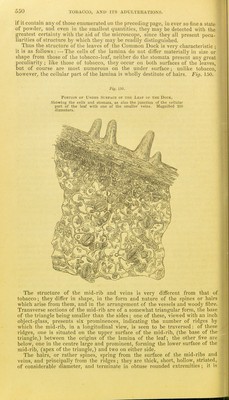
![o48 BircVs-eye differs from the other varieties in containing the mid-ribs of the leaves, the transverse slices of which have been fancifully compared to the eves of birds, J r J The prmcipal kinds of roll tobacco are Pigtail, Bogie, Alloa, Negro-head, and Cavendish. The three first arc used entirely for chewing, and are distinguished by the difference in the thickness of the ropes, Alloa being the thinnest and Bogie the thickest. Negro-head and Cavendish are used nearly exclusively for smoking. Negro-head is manufactured in the form of a thickish rope ; it also sometimes consists of two ropes coiled together in short pieces. Cavendish is made in small square flat cakes, about an inch and a half wide by five inches long. In that portion of the report published already we have enumerated the different species from which the several varieties of tobacco are obtained, described the cul- tivation of the tobacco plant in Virginia, gave the minute structure of the leaves, their chemical composition and properties, the processes by which raw or un- manufactured is converted into manufactured tobacco, and, lastly, we described the different varieties of cut and roll tobacco; these particulars were necessary in order that the subject of the adulteration of tobacco might be the more easily and fully compi'ehended. On referring to Act 5 & 6 Vict., entitled, An Act to amend an Act of the fourth year of,her present Majesty, to discontinue the Excise survey on tobacco, and to provide other regulations in lieu thei-eof, (10th August, 1842,) we find the following provisions relating to the adulteration of tobacco : — By Clause ]. it is enacted, that no manufactui-er of tobacco shall, in manu- facturing any tobacco, make use therewith of any other material, or any other liquid substance, or matter, or thing, than water only; or in manufacturing any snuff, make use therewith of any other material, or any other liquid, or substance, or matter, or thing, than water, or water and salt, or alkaline salts only, or lime-water, in snuff known as Welch or Irish snuff, under a penalty of three hundred pounds. Clause 2. allows of the use of essential oils for scenting and flavouring snuffs, as also oil in making up spun or roll tobacco. By Clauses, it is provided, that any manufacturer of, dealer in, or retailer of tobacco, who shall receive, or take into, or have in his possession, or shall sell, send out, or deliver, any tobacco or snuff which shall have been manufactured with, or shall have had added thereto, or mixed therewith, any other substance than water, shall forfeit two hundred pounds. Clause 4. declares all tobacco manufactured otherwise than with water, or the other substances allowed by law, as oil in the making up of roll tobacco, or salt, or alkaline salts, or lime-w-ater, in snuffs, to be forfeited. By Clause 5. it is enacted, that no manufacturer of tobacco shall receive, or take into, or have in his possession, any sugar, treacle, molasses, or honey, (except for the necessary and ordinary use of his family,) nor any commings or roots of malt, or any ground or unground roasted grain, ground or unground chicory, lime, sand (not being tobacco-sand), umber, ochre, or other earths, sea- weed, ground wood, moss, or weeds, or any leaves, or any herbs or plants (not being tobacco leaves or plants) respectively, nor any substance, syrup, liquid, or preparation or thing, to be used or capable of being used as a substitute for, or to increase the weight of, tobacco or snuff, on pain of forfeiting the same and two hundred pounds. Clause 6. provides that manufacturers of tobacco who are also grocers may carry on the two trades or businesses in separate premises. It states, It sh;ill be lawful for the Commissioners of Excise to authorise and empower such person to carry on the business of a manufacturer of tobacco, without beuig subject to the same penalty by reason of having such of the said commodities as are usually sold bv grocers in his possession, so as his premises for manufacturing tobacco be separated, to the satisfaction of the Commissioners of Excise, from, and all internal communication prevented with, his premises used for carrying](https://iiif.wellcomecollection.org/image/b20385419_0608.jp2/full/800%2C/0/default.jpg)