Food and its adulterations : comprising the reports of the Analytical sanitary commission of "The Lancet" for the years 1851 to 1854 inclusive, revised and extended being records of the results of some thousands of original microscopical and chemical analyses of the solids and fluids consumed by all classes of the public ... / by Arthur Hill Hassall.
- Arthur Hill Hassall
- Date:
- 1855
Licence: Public Domain Mark
Credit: Food and its adulterations : comprising the reports of the Analytical sanitary commission of "The Lancet" for the years 1851 to 1854 inclusive, revised and extended being records of the results of some thousands of original microscopical and chemical analyses of the solids and fluids consumed by all classes of the public ... / by Arthur Hill Hassall. Source: Wellcome Collection.
617/726 page 557
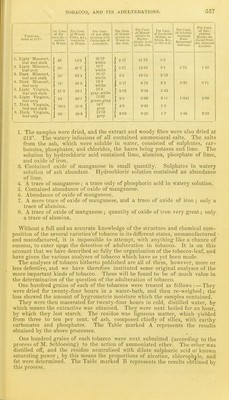
![Tobaccos, (Iriwl at Vl'i^. IT Cent. of Kx. tract, olllhic in Water, 1. Light leaf 2. Light leaf 3. Dark leaf 4. Darli leaf 5. Light leal' G. Light leaf 7. Darlt leaf 8. Dark leaf ' Missouri, and stalk Missouri, only Missouri, and stalk Missouri, only Virginia, \m\ stalk Virginia, only Virginia, and stalk Virginia, only ] 49- I no- I 50- I - j 515 I 54- j 52- Per Cent, of Woolly Fibre, &o , in.soliilitu in Water. 54-9 [ 47-7 I 52'4 I 50 6 I 531 J 46-1 J 51-8 ^ 49-8 I Ter Cent, of Ash after treating witli Carboiijjte of Ammonia. •20-97 white 19-7 wliite 16-47 white i.i-a white 16-4 gray-whito 11- 97 green-gray 14-7 gray 12- 53 gray Per Cent, of .Alatter soliklile in Water In the A:ih. 217 1- 77 4-2 2- 17 2-53 2-0 4-8 2-63 Per Cent, of Matter soluble in Hydro- chloric AcU\ in the .Abli. U-73 12-83 10-14 8-73 8-54 G-86 8-40 8-20 Per Cent, of Insohtblu •Matter, nii Silica, &c., In the Asli. 5-9 5-1 2-13 2- 9 5 33 3- 11 1-5 1-7 Per Cent, of Alcohol obtained from fermented Infusion. 0-75 0-3.i 1-045 1-46 1. The samples were dried, and the extract and woody fibre were also dried at 212°. The watery infusions of all contained ammoniacal salts. The salts from the ash, which were soluble in water, consisted of sulphates, car- bonates, phosphates, and chlorides, the bases being potassa and lime. The solution by hydrochloric acid contained lime, alumina, phosphate of lime, and oxide of iron. 3. Contained oxide of manganese in small quantity. Sulphates in watery solution of ash abundant. Hydrochloric solution contained an abundance of lime. 4. A trace of manganese ; a trace only of phosphoric acid in watery solution. 5. Contained abundance of oxide of manganese. 6. Abundance of oxide of manganese. 7. A mere trace of oxide of manganese, and a trace of oxide of iron ; only a trace of alumina. 8. A trace of oxide of manganese; quantity of oxide of iron very great; only a trace of alumina. Without a full and an accurate knowledge of the structure and chemical com- position of the several varieties of tobacco in its different states, unmanufactured and manufactured, it is impossible to attempt, with anything like a chance of success, to enter upqn the detection of adulteration in tobacco. It is on this account that we have described so fully the organisation of the tobacco-leaf, and have given the various analyses of tobacco which have as yet been made. The analyses of tobacco hitherto published are all of them, however, more or less defective, and we have therefore instituted some original analyses of the more important kinds of tobacco. These will be found to he of much value in the determination of the question of the adulteration of tobacco. One hundred grains of each of the tobaccos were treated as follows : — They were dried for twenty-four hours in a water-bath, and then re-weighed; the loss showed the amount of hygrometric moisture which the samples contained. They were then macerated for twenty-four hours in cold, distilled water, by which means the extractive was obtained. They were next boiled for an hour, by which they lost starch. The residue was ligneous matter, which yielded from three to ten per cent, of ash, composed chiefly of silica, with earthy carbonates and phosphates. The Table marked A represents the results obtained by the above processes. One hundred grains of each tobacco were next submitted (according to the process of M. Schloesing) to the action of ammoniated ether. The ether was distilled off, and the residue neutralised with dilute sulphuric acid ol known saturating power ; by this means the proportions of nicotine, chlorophvle, and fat were determined. The Table marked B represents the results obtained by this process.](https://iiif.wellcomecollection.org/image/b20385419_0617.jp2/full/800%2C/0/default.jpg)