The diseases of dogs; their causes, symptoms, and treatment : to which are added instructions in cases of injury and poisoning, and brief directions for maintaining a dog in health / by Hugh Dalziel.
- Dalziel, Hugh.
- Date:
- 1905
Licence: In copyright
Credit: The diseases of dogs; their causes, symptoms, and treatment : to which are added instructions in cases of injury and poisoning, and brief directions for maintaining a dog in health / by Hugh Dalziel. Source: Wellcome Collection.
56/188 page 38
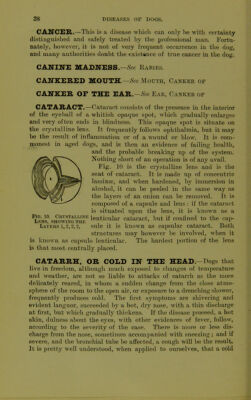
![CANCER .—This is a disease which can only he with certainty distinguished and safely treated by the professional man. Fortu- nately, however, it is not of very frequent occurrence in the dog, and many authorities doubt the existence of true cancer in the dog. CANINE MADNESS.—See Rabies. CANKERED MOUTH.— See Mouth, Canker of CANKER OF THE EAR.—See Ear, Canker of CATARACT.—Cataract consists of the presence in the interior of the eyeball of a whitish opaque spot, which gradually enlarges and very often ends in blindness. This opaque spot is situate on the crystalline lens. It frequently follows ophthalmia, but it may be the result of inflammation or of a wound or blow. It is com- monest in aged dogs, and is then an evidence of failing health, and the probable breaking up of the system. Nothing short of an operation is of any avail. Fig. 10 is the crystalline lens and is the seat of cataract. It is made up of concentric laminae, and when hardened, by immersion in alcohol, it can be peeled in the same way .as the layers of an onion can be removed. It is composed of a capsule and lens : if the cataract is situated upon the lens, it is known as a FLk'ns° showing tYie' lenticu]ar cataract, but if confined to the cap- Layers l, 2,2,2, sule it is known as capsular cataract. Both structures may however be involved, when it is known as capsulo lenticular. The hardest portion of the lens is that most centrally placed. CATARRH, OR COLD IN THE HEAD.—Bogs that live in freedom, although much exposed to changes of temperature and weather, are not so liable to attacks of catarrh as the more delicately reared, in whom a sudden change from the close atmo- sphere of the room to the open air, or exposure to a drenching shower, frequently produces cold. The first symptoms are shivering and evident languor, succeeded by a hot, dry nose, with a thin discharge at first, but which gradually thickens. If the disease proceed, a hot skin, dulness about the eyes, with other evidences of fever, follow, according to the severity of the case. There is more or less dis- charge from the nose, sometimes accompanied with sneezing ; and if severe, and the bronchial tube be affected, a cough will be the result. It is pretty well understood, when applied to ourselves, that a cold](https://iiif.wellcomecollection.org/image/b28101443_0056.jp2/full/800%2C/0/default.jpg)
 No text description is available for this image
 No text description is available for this image
 No text description is available for this image