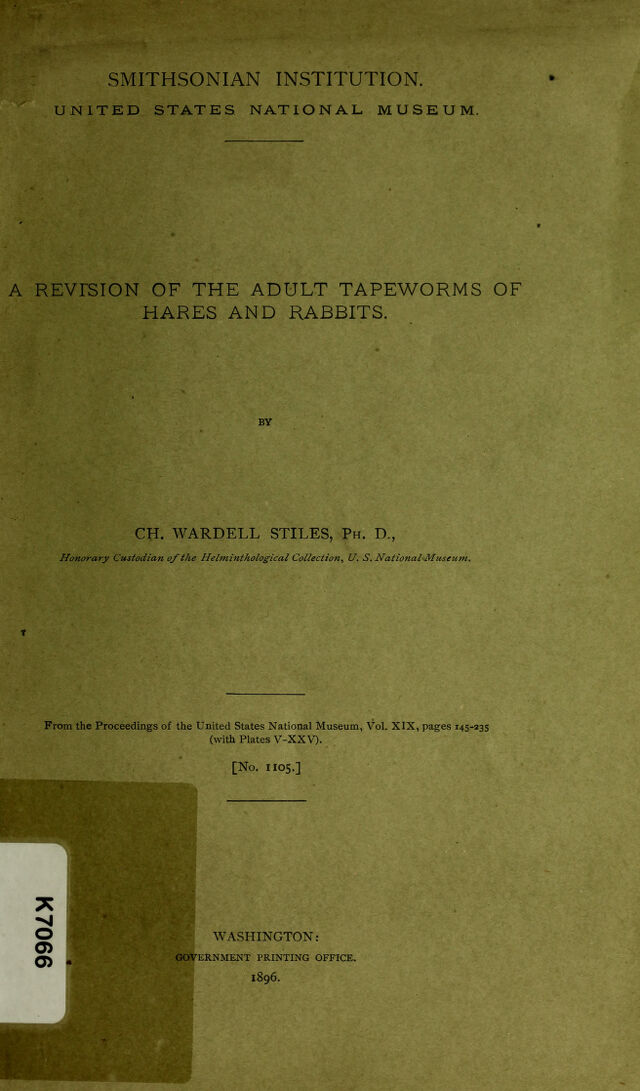
A revision of the adult tapeworms of hares and rabbits / by Ch. Wardell Stiles.
- Charles Wardell Stiles
- Date:
- [1896]
Licence: Public Domain Mark
Credit: A revision of the adult tapeworms of hares and rabbits / by Ch. Wardell Stiles. Source: Wellcome Collection.
50/138
![VOL XIX. bur gradually the uterus develops to such an extent that it suppresses all the genital glands. The cirrus pouch becomes indistinct, bat the vagina can be traced in nearly all segments. As the uterus increases in size it gives rise to proximal and distal branches, but the latter are far less regular than those of the European G. pectinata. In the posterior segments it is generally difficult to dis- tinguish the two uteri. The ova measure 60 to 64 p iu diameter; the bulb of the pyriform body, 12 to 16 p. This is the species (vnr. angusta) upon which my paper, “A double-pored cestode with occasional single pores” was based, and since writing that note another case of the same variation was noticed. On account of the numerous variations in the position of the genital pores, uterus, etc., noticed in the specimens sf udied, I proposed to name the worm Gtenotcenia variabilis. Larval stage.—The young specimens described on page 201 were col- lected in the same locality as the species here described, and from the same host; and it seems probable that the unarmed young mentioned on page 201 are the young of either G. variabilis or G. perplexa. Diagnosis.—Cittotcenia variabilis (Stiles, 1895), Stiles & Hassall, 1896. (American representative of G. pectinata.) Strobila attains 100 to 180 mm. in length and 10 mm. in breadth. Head small, about 0.3 to 0.6 mm. in breadth; it may or may not be defined from the neck accord- ing to contraction. Neck very short, segmentation beginning almost immediately back of the head; segments always much broader than long. Genital anlagen appear very early, about 5 to 10 min. from the head. Genital pores double, in about the middle third of the lateral margin. Male organs: Testicles about 60 to 100 in each segment, con- fined between the ovaries to the dorsal portion of the distal half of the median field; cirrus pouch about 0.4 mm. long, narrow and very indis- tinct, lying dorsally of the vagina on both sides of the segment. Female organs: Ovary, shell gland, and vitellogene gland resemble the corre- sponding organs of Moniezia; they lie median of longitudinal canals, about 1.3 mm. from the lateral margin; the vagina is rather distinct, lies ventrally of the cirrus pouch, and for about 0.5 mm. from the pore it is surrounded by deeply staining cells; uterus may be double or single (in the same specimen) and may produce proximal and distal branches; ova 60 to 64 p in diameter; bulb of pyriform body 12 to 16 p. Longitudinal nerve ‘about 0.6 mm. from the lateral margin; ventral canal large with thin lining; dorsal canal much smaller than ventral canal, dorso-median of ventral canal, with thick lining; transverse canals connect ventral canals [no injections made for secondary longi- tudinal canals]. Genital ducts and uterus pass from median to lateral field on the dorsal side of the longitudinal canals and nerves. Host.—Cottontail Rabbit (Lepns sylvaticus), by Hassall; Marsh Hare (L. painstris)y by Mills. Types.—Bureau of Animal Industry, Cestode series No. 117 desig- nated as type and deposited in the United States National Museum. Paratyjies distributed as follows: Collection of Bureau of Animal](https://iiif.wellcomecollection.org/image/b28058124_0050.jp2/full/800%2C/0/default.jpg)