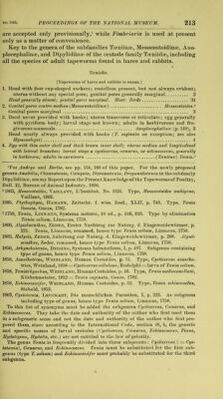
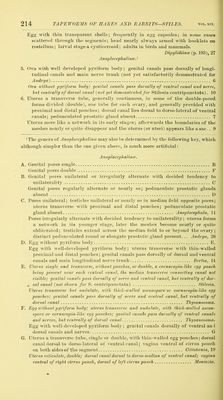
A revision of the adult tapeworms of hares and rabbits / by Ch. Wardell Stiles.
- Charles Wardell Stiles
- Date:
- [1896]
Licence: Public Domain Mark
Credit: A revision of the adult tapeworms of hares and rabbits / by Ch. Wardell Stiles. Source: Wellcome Collection.
67/138
![Of course our efforts at classification are experimental—we all admit that; hut from the very nature of things all efforts at classification in practically unknown groups are and must be experimental. The classi- fications must be changed time and again as new facts are discovered. Nor have our experiments (or, as Meyner puts it, “derartige Experi- mented) counted upon immediate general recognition (allgemeine Aner- kennung); it was not with that end in view that we published them. We do not expect to see our proposed classifications adopted by zoolo- gists at large until they have stood the test of other specialists in helminthology. We have not heard as yet, however, of any marked disapproval of the genera proposed from workers who were acquainted with the forms and who were competent to pass judgment on the case. When such authors propose a better classification, they can certainly count on Blanchard, Bailliet, Hassall, and myself as four helmintholo- gists who are ready to follow them. At present, however, I maintain that the classification originally proposed by Blanchard and since that time considerably expanded by Bailliet, Hassall, and myself is a far more natural and satisfactory classification of the forms treated than any other classification ever proposed for the same forms. I am fully convinced, after a study of several thousand specimens, that the main features of the proposed division will stand, although the details of the system may undergo some changes. Helminthologists, as a class, are ultra-conservative in every line except species-making—and yet as long as the Budolplii-Diesing school exerts such a powerful influence in wield- ing the yardstick instead of the microscope, perhaps this generic con- servatism should be looked upon as a blessing. A third error of Meyner’s is that he does not understand the views which he has attempted to criticise, or the relative rank of the groups proposed, and he ascribes to authors propositions which they never made. Thus he states (page 6): Diese Anoplocephalinen tkeilt er (R. Blancliard) dann mit Riicksicht auf die Anord- nung der Geschlechtsorgane in 3 Unterfamilien [! ] ein und zwar (1) Genre Moniezia * * *; (2) Genre knoplocephala * * *; (3) Genre Bertia * * *. Meyner thus makes the terms subfamily and genus synonymous— rather a novel idea in systematic zoology; he accredits (page 8) Blanch- ard and Bailliet with a family “Anoploceplialen,” although he states a few lines before that Bailliet accepted “Anoplocephaline” as a sub- family. Upon the same page he speaks of Bertia as a genus and Cteno- tcenia and Andrya as uArten.v It does not seem to me at all strange that our efforts should “fail totally in their object” with a worker who confounds such terms as species, genus, subfamily, and family. A fourth error into which Meyner has fallen in the passage quoted is the assumption that we have taken only a few species into consid- eration in making our classifications. True, we have not felt called upon to give a list of all the species of cestodes with which we have acquaintance, either through personal study or through the publications Proc. N. M. vol. xix 14](https://iiif.wellcomecollection.org/image/b28058124_0067.jp2/full/800%2C/0/default.jpg)