The hand : its mechanism and vital endowments as evincing design and illustrating the power, wisdom and goodness of God / Sir Charles Bell ; preceded by an account of the author's discoveries in the nervous system by Alexander Shaw.
- Charles Bell
- Date:
- 1885
Licence: Public Domain Mark
Credit: The hand : its mechanism and vital endowments as evincing design and illustrating the power, wisdom and goodness of God / Sir Charles Bell ; preceded by an account of the author's discoveries in the nervous system by Alexander Shaw. Source: Wellcome Collection.
Provider: This material has been provided by King’s College London. The original may be consulted at King’s College London.
46/328 page 6
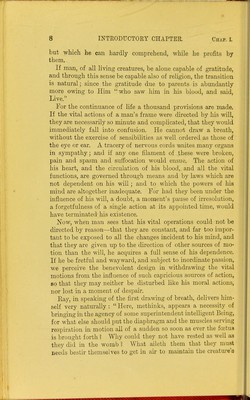
![same. However this may be, all I contend for is the necessity of certain relations being established between the planet and the frames of all which inhabit it; between the great mass and the physical properties of every part; that in the mechanical construction of animals, as in their endowments of life, they are created in relation to the whole, planned together and fashioned by one Mind. A comparison made between the system of an animal body, and the condition of the earth's surface, is highly illustrative of design in both. In the animal, we see matter withdrawn from the influences which arrange things dead and inorganic; but this matter, thus appropriated to the animal, and newly endowed through the influence of life, continues to possess such qualities of inanimate matter a& are necessary to constitute the living being a part of the system—an inhabitant of the earth. To what, then, does this argument lead ] Is it not, that as the beautiful structure of the animal, and the perfection in the arrangement of its parts, demonstrate design—so design extends to the condition of the earth also; and over both there is a ruling Intelligence 1 Men who have studied deeply, and who have become autho- rities in natural science, acquire a happy spirit of contentment and true philosophy, of which we have examples in Grew,* in Ray, and in Linnaeus. The last, resting from his great labours in universal nature, and struck with the perfection and order evinced in the whole, breaks out, very naturally and eloquently, in admiration of the just relation of all things, as proving them to be the work of one Almighty Being. Then considering the great globe as a Museum,t furnished forth with the works of the Supreme Being, man, he adds, is placed in the midst of it, as alone capable of comprehending and valuing it. And if this be true, as certainly it is, what then becomes his duty] Moralists and divines, with Nature herself, testify that the pur- pose of so much beauty and perfection being made manifest to man, is that he may study and celebrate the works of God: and that if he fail in this, he will be wanting in those contem- * A naturalist, who wrote on the + These sentiments are best ex- anatomy of Plants; also, Cosmo- pressed in his Preface to the Cata- nia Sacra: a Discourse on the logue of the Museum of Adolphui Universe, as the creature and king- Trederick of Sweden, dom of God.](https://iiif.wellcomecollection.org/image/b21293120_0046.jp2/full/800%2C/0/default.jpg)

 No text description is available for this image
 No text description is available for this image
 No text description is available for this image