Report of Commission on the Cattle Plague / by Andrew Davidson, Secretary to Commission.
- Andrew Davidson
- Date:
- 1880
Licence: Public Domain Mark
Credit: Report of Commission on the Cattle Plague / by Andrew Davidson, Secretary to Commission. Source: Wellcome Collection.
Provider: This material has been provided by Royal College of Physicians, London. The original may be consulted at Royal College of Physicians, London.
47/148 (page 43)
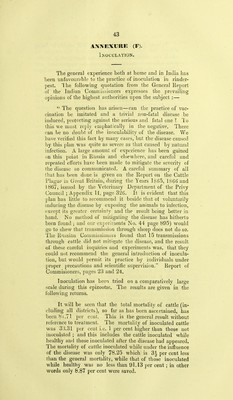
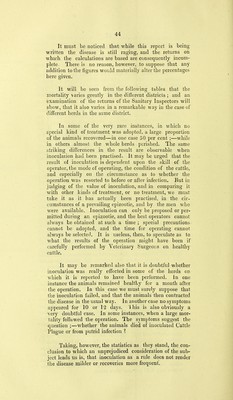
![AXXEXURE (F). Inoculation. The general experience both at home and in India has been unfavourable to the practice of inoculation in rinder- pest. The following quotation from the General Report of the Indian Commissioners expresses the prevailing opinions of the highest authorities upon the subject :— The question has arisen—can the practice of vac- cination be imitated and a trivial non-fatal disease be induced, protecting against the serious and fatal one 1 To this Ave must reply emphatically in the negative. There can ]>e no doubt of the inoculability of the disease. We have verified this fact by many cases, but the disease caused by this plan was quite as severe as that caused by natural infection. A large amount of experience has been gained on this point in Russia and elsewhere, and careful and repeated efforts have been made to mitigate the severity of the disease so communicated. A careful summary of all that has been done is given on the Report on the Cattle Plague in Great Britain, during the Years lS65, 1866 and 1867, issued by the Veterinary Department of the Privy Council ; Appendix II, page 326. It is evident that this plan has little to recommend it beside that of voluntarily mducing the disease by exposing the animals to infection, except its greater certainty and the result being better in hand. No method of mitigating the disease has hitherto been found; and our experiments No. 44 page 895) would go to shew that transmission through sheep does not do so. The Russian Commissioneis found that 15 transmissions through cattle did not mitigate the disease, and the result of these careful inquiries and experiments was, that they could not recommend the general introduction of inocula- tion, but would permit its practice by individuals under proper })recautions and scientific supervision. Report of Commisioners, pages 23 and 24. Inoculation has been tried on a comparatively large scale during this epizootie. The results are given in the following returns. It will be seen that the total mortality of cattle (in- cluding all districts), so far as has been ascertained, has been 8i.71 per cent. This is the general result without reference to treatment. The mortality of inoculated cattle was 33.31 per cent i.e. 1 per cent higher than those not inoculated ; and this includes the cattle inoculated while healthy and those inoculated after the disease had appeared. The mortality of cattle inoculated while under the influence of the disease was only 78.25 which is 3^ per cent less than the general mortality, while that of those inoculated while healthy was no less than 91.13 per cent; in other words only 8.87 per cent were saved.](https://iiif.wellcomecollection.org/image/b24749783_0049.jp2/full/800%2C/0/default.jpg)