[Report 1921] / Medical Officer of Health, Salop / Shropshire County Council.
- Shropshire (England). County Council.
- Date:
- 1921
Licence: Attribution 4.0 International (CC BY 4.0)
Credit: [Report 1921] / Medical Officer of Health, Salop / Shropshire County Council. Source: Wellcome Collection.
18/52 (page 8)
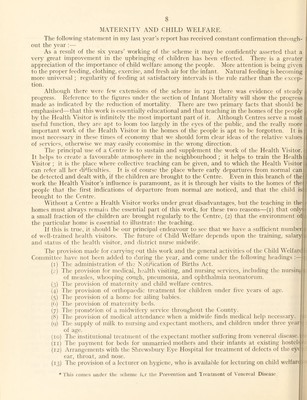
![MATFJ^NITV AND CHILD WELFAIHL The following statement in my Iasi year’s report has received constant confirmation through- j out the year :— j As a result of the six years’ working of the scheme it may be confidently asserted that a very great improvement in the upbringing of children has been effected. There is a greater t appreciation of the importance of child welfare among the people. More attention is being given | to the proper feeding, clothing, exercise, and fresh air for the infant. Natural feeding is becoming t more universal ; regularity of feeding at satisfactory intervals is the rule rather than the excep- ■ tion. Although there were few extensions of the scheme in 1921 there was evidence of steady ; progress. Reference to the figures under the section of Infant Mortality will show the progress i made as indicated by the reduction of mortality. There are two primary facts that should be emphasised—that this work is essentially educational and that teaching in the homes of the people p by the Health Visitor is infinitely the most important part of it. Although Centres serve a most | useful function, they are apt to loom too largely in the eyes of the public, and the really more j important work of the Health Visitor in the homes of the people is apt to be forgotten. It is | most necessary in these times of economy that we should form clear ideas of the relative values I of services, otherwise we maj- easily economise in the wrong direction. j The principal use of a Centre is to sustain and supplement the work of the Health Visitor. 11 It helps to create a favourable atmosphere in the neighbourhood ; it helps to train the Health I ( Visitor ; it is the place where collective teaching can be given, and to which the Health Visitor j can refer all her difficulties. It is of course the place where early departures from normal can i be detected and dealt with, if the children are brought to the Centre. Fven in this branch of thei ’ work the Health Visitor’s influence is paramount, as it is through her visits to the homes of the| I people that the first indications of departure from normal are noticed, and that the child is| { brought to the Centre. Without a Centre a Health Visitor works under great disadvantages, but the teaching in the 1 homes must always remain the essential part of this work, for these two reasons—(i) that onh^ 1 a small fraction of the children arc brought regularly to the Centre, (2) that the environment of : the particular home is essential to illustrate the teaching. If this is true, it should be our principal endeavour to see that we have a sufficient numberLi of well-trained health visitors. The future of Child Welfare depends upon the training, salary ( and status of the health visitor, and district nurse midwife. The provision made for carrying out this work and the general activities of the Child Welfan.}i Committee have not been added to during the year, and come under the following headings 1 (I) The administration of the Notification of Births Act. (.:) 'I'lie provision for medical, health visiting, and nursing services, including the nursinL;i of measles, whooping cough, pneumonia, and ophthalmia neonatorum. (3) The jirovision of maternity and child welfare centres. (4) The provision of orthopaedic treatment for children under five years of age. (5) The provision of a home for ailing babies. (()) The provision of maternity beds. 1 (7) The promotion of a midwifery service throughout the Count}’. (8) The juovision of medical attendance when a midwife finds medical help necessary, j (i)) The su])ply of milk to nursing and expectant mothers, and children under three yoarl of age. (10) 'I'he institutional treatment of the expectant mother suffering from venereal disease. (II) The ])ayment for beds for unmarried mothers and their infants at existing hosteb (12) Arrangements with the Slirewsbury Fye Hospital for treatment of defects of the ey* ear, throat, and nose. (13) The provision of a lecturer on hygiene, who is available for lecturing on child welfari *'I'his conics under the scheme for the Prevention and Treatment of X'enercal Disease.](https://iiif.wellcomecollection.org/image/b30086590_0020.jp2/full/800%2C/0/default.jpg)