[Report 1921] / Medical Officer of Health, Salop / Shropshire County Council.
- Shropshire (England). County Council.
- Date:
- 1921
Licence: Attribution 4.0 International (CC BY 4.0)
Credit: [Report 1921] / Medical Officer of Health, Salop / Shropshire County Council. Source: Wellcome Collection.
23/52 (page 11)
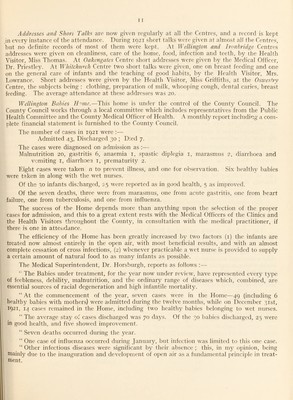
![Addt'esses and Shon. Talks are now given regularly at all the Centres, and a record is kept in every instance of the attendance. During 1921 sliort talks were given at almost all the Centres, hut no definite records of most of them were kept. At Wellington and Ironhridge Centres addresses were given on cleanliness, care of the home, food, infection and teeth, by the Health Visitor, Hiss Thomas. At Oakengales Centre short addre.sses were given by the Medical Officer, Dr. Priestley. At Whiichuyeh Centre two short talks were given, one on breast feeding and one on the general care of infants and the teaching of good habits, by the Health Visitor, Mrs. Lowrance. Short addresses were given by the Health Visitor, Miss Griffiths, at the Oswestry Centre, the subjects being : clothing, preparation of milk, whooping cough, dental caries, breast feeding. The average attendance at these addresses was 20. Wellington Babies H-^ine.—This home is under the eontrol of the County Council. The County Council works through a local committee which includes representatives from the Public Health Committee and the County Medical Officer of Health. A monthly report including a com¬ plete financial statement is furnished to the County Council. The number of cases in 1921 were :— Admitted 43, Discharged 30 ; Died 7. The cases were diagnosed on admission as :— Malnutrition 20, gastritis 6, anaemia i, spastic diplegia i, marasmus 2, diarrhoea and vomiting i, diarrhoea i, prematurity 2. Eight cases were taken n to prevent illness, and one for observation. Six healthy babies were taken in along with the wet nurses. Of the 30 infants discharged, 25 were reported as in good health, 5 as improved. Of the seven deaths, three were from marasmus, one from acute gastritis, one from heart failure, one from tuberculosis, and one from influenza. The success of the Home depends more than anything upon the selection of the proper cases for admission, and this to a great extent rests with the Medical Officers of the Clinics and the Health Visitors throughout the County, in consultation with the medical practitioner, if there is one in atteudance. The efficiency of the Home has been greatly increased by two factors (i) the infants are treated now almost entirely in the open air, with most beneficial results, and with an almost complete cessation of cross infections, (2) whenever practicable a wet nurse is provided to supply a certain amount of natural food to as many infants as ])o.ssible. The IMedical Superintendent, Dr. Horsburgh, reports as follows : — The Babies under treatment, for the year now under review, have represented every type of feebleness, debility, malnutrition, and the ordinary range of diseases which, combined, are essential sources of racial degeneration and high infantile mortality. “ At the commencement of the year, seven ca.ses were in the Home—49 (including 6 healthy babies with mothers) were admitted during the twelve months, while on December 31st, 1921, 14 cases remained in the Home, including two healthy babies belonging to wet nurses. “ The average stay of cases discharged was 70 days. Of the 30 babies di.scharged, 23 were in good health, and five showed im])ro\-ement. “ Seven deaths occurred during the year. “ One case of influenza occurred during Januaiy, but infection was limited to this one case. “ Other infectious diseases were significant by their absence ; this, in my opinion, being mainly due to the inauguration and development of open air as a fundamental jirinciple in treat¬ ment.](https://iiif.wellcomecollection.org/image/b30086590_0025.jp2/full/800%2C/0/default.jpg)