[Report 1921] / Medical Officer of Health, Salop / Shropshire County Council.
- Shropshire (England). County Council.
- Date:
- 1921
Licence: Attribution 4.0 International (CC BY 4.0)
Credit: [Report 1921] / Medical Officer of Health, Salop / Shropshire County Council. Source: Wellcome Collection.
31/52 (page 19)
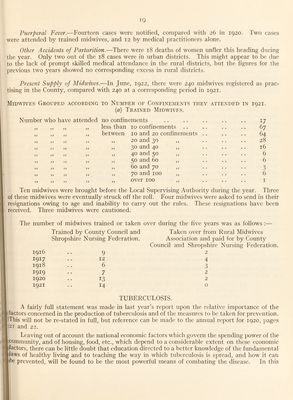
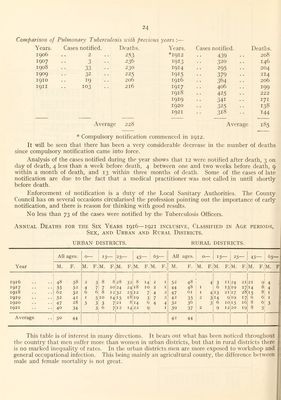
![were attended by trained midwives, and 12 by medical practitioners alone. Oilier Accidents of Parturition.—There were 18 deaths of women under this heading during the year. Only two out of the 18 cases were in urban districts. This might appear to be due to the lack of prompt skilled medical attendance in the rural districts, but the figures for the previous two years showed no corresponding exxess in rural districts. Present Supply of Midwives.—In June, 1922, there were 240 midwives registered as prac¬ tising in the County, compared with 240 at a corresponding period in 1921. Midwives Grouped according to Number oe Coneinejients they attended in 1921. [a) Trained Midwtves. Number who have attended no confinements less than 10 confinements between 10 and 20 confinements ,, 20 and 30 „ 30 and 40 „ 40 and 50 ,, 50 and 60 ,, ,, 60 and 70 ,, ,, 70 and 100 „ ,, over 100 17 67 64 28 16 6 6 O 6 I Ten midwdves were brought before the Local Supervising Authority during the year. Three of these midw’ives were eventually struck off the roll. Four midwives were asked to send in their resignations owing to age and inability to carry out the rules. These resignations have been received. Three midwives were cautioned. The number of midwives trained or taken over during the five years w'as as follows :— Trained by County Council and Taken over from Rural IMidwives Shropshire Nursing Federation. Association and paid for by County Council and .Shropshire Nursing Federation. 1916 .. 9 2 1917 .. 12 4 1918 .. 6 3 1919 .. 7 2 1920 .. 13 2 1921 .. 14 o TUBERCULOSIS. A fairly full statement was made in last year’s report upon the relative importance of the ifactors concerned in the production of tuberculosis and of the measures to be taken for prevention. This will not be re-stated in full, but reference can be made to the annual report for 1920, ])ages 21 and 22. Leaving out of account the national economic factors which govern the spending power of the community, and of housing, food, etc., which depend to a considerable extent on these economic ifactors, there can be little doubt that education directed to a better knowledge of the fundamental iaws of healthy living and to teaching the way in which tuberculosis is sj)read, and how it can prevented, will be found to be the most powerful means of combating the disease. In this](https://iiif.wellcomecollection.org/image/b30086590_0033.jp2/full/800%2C/0/default.jpg)