Annual report of the Director, Medical & Health Department / Colony of Mauritius.
- Mauritius. Medical and Health Department
- Date:
- [1923]
Licence: Public Domain Mark
Credit: Annual report of the Director, Medical & Health Department / Colony of Mauritius. Source: Wellcome Collection.
14/48 (page 12)
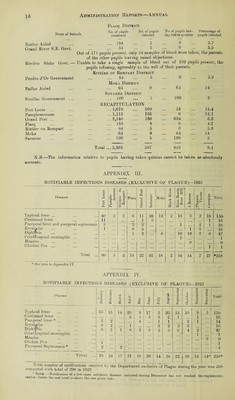
![21,521 notices, orders and requests were served under the several Sanitary Ordinances and Regulations. Of these 3,330 were not complied with and led to 2.018 prosecutions resulting in aggregate fines of Rs. 7,494.50. Revenue.—The revenue derived from fees collected in Government Cemeteries, Markets and Abattoirs was Rs. 17,112.50, Rs. 2,237.45 and Rs. 3,759 respectively and Appendix XIX shows the total number of cattle slaughtered in all the Abattoirs of the Colony. Schools.—The Government and State Aided Primary Schools were each visited at least twice during the year by the Health Officers. (In Port Louis, the inspection of schools is made on methods devised by Dr. A. Balfour and the present Director). The report of the Medical Inspector is given in Appendix XX. The same methods are being gradually extended to the other districts. A report on the start made in Plaines Wilhems is given in Annexure to Appendix XXI, the report by the Medical Officer of Health for Plaines Wilhems. In Flacq District also a start has already been made. As a general rule, the school buildings are buildings which were not constructed for the purpose they are now used for. The school latrines, as a result of the Sanitation Campaign, are in several districts good and generally well upkept, but there still remain numerous cases where improvements are urgently needed. Water-Supply.—As regards the domestic water-supply, the districts of Plaines Wilhems and Moka, using mostly the Mare-aux-Vacoas water, have the best supply possible. In the extra urban area of Plaines Wilhems and in the upper parts of Moka district, the supply is derived from wells and rivers and is not good in most cases. In Pamplemousses, the supply from canals and rivers is of suspicious quality but that from Le Plessis and Bassin Loulou springs is good and the water drawn from wells is of fair quality. The hamlet of Triolet was towards the end of the year, provided with a piped supply derived from a pumping station at St. Andre well. Riviere du Rempart has good supplies from caves and wells except those derived from canals and rivers which are bad. In populous hamlets in Flacq district, the supply is good, derived from River Dubois and Rivulets Jamblon and Monneron. In out of the way localities, the water is drawn from wells, springs and rivers and is generally not good. In Grand Port, the supply from Be-Manique River is good but has proved inadequate and on several occasions has flowed intermittently. Water derived from wells, springs, Rivulet Delices and River des Creoles is of fair qualitv, but in other cases it is very bad e g the supply of Old Grand Port, Grand Sable and PetitSable. During November and December, the inhabitants along the coast line between Old Grand Port and Grand Sable have been practically short of all water. They had to ge their supply from Mahebourg by boat. This is a rather a recurrent matter, the feeders of the locality being usually dry in the hot season. In Savanne,. Rivers des Anguilles and Patate and other rivers, with wells and canals, constitute tlie principal sources of water supply. The pipe supplies of Chemin Grenier and and ibouillac have proved inadequate during the dry season. Most of the wells and springs supplying watei aie liable to pollution and the water is bad. In Black River, the public fountains supply fairly good water but the water from rivers, wells and canals are liable to pollution during heavy rain. At Bambous and Clarens, the supply has been improved by the provision of additional public fountains. At Chamarel, spnngs and rivers afford a good supply and indigenous water-borne diseases have been unknown for years m the locality. The water supply of Port Louis is derived from Grand River North West and Bathurst Canal. Government Establishments and some private firms and buildings are provided with Mare-aux-Vacoas water. The first two supplies of water are unfit and unsafe. It is hoped that the Chlorination Plant under erection at Failles, in the bed of Grand River N. W. will SZltfwntr?'ki W d / iat fi te!’ed Chlorinated water will be substituted to the crude, 1 P 1 ia 1 0 fhe inhabitants of Port Louis are obliged to consume. ^ a nmst important factor towards the health of a community and the a l • L1 Si e a en. le 4uestl°n in hand and the water supplies of country districts and Ws 7 improved mostly by piped supplies from pure sources or unpolluted springs Sanii^Zl^reer'S ^-APpendix XXII summarises the work carried out by the durirm %] 92^T?^^ 1 11 babo n. Campaign has been pushed on very energetically the Medical and Hp dth YY + 1S \ lecaP1Pdation of the ordinances, regulations &c. affecting regulations W t ^ dung the ^ear- Wl11 be noticed that New gulations hav e been put into force regarding Septic Tanks, Disposal of Human Excreta and](https://iiif.wellcomecollection.org/image/b31484128_0014.jp2/full/800%2C/0/default.jpg)