Effect of change of posture - without active muscular exertion - on the arterial and venous pressures / Joseph H. Barach and W.L. Marks.
- Barach, Joseph H. (Joseph Hayem), 1883-1954.
- Date:
- 1913
Licence: Public Domain Mark
Credit: Effect of change of posture - without active muscular exertion - on the arterial and venous pressures / Joseph H. Barach and W.L. Marks. Source: Wellcome Collection.
5/16 page 3
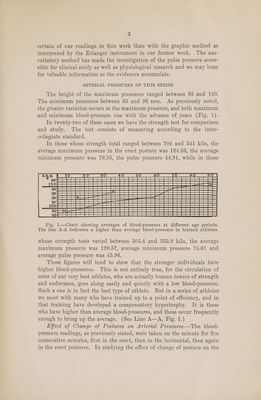
![certain of our readings in this work than with the graphic method as interpreted by the Erlanger instrument in our former work. The aus- cultatory method has made the investigation of the pulse pressure acces- sible for clinical study as well as physiological research and we may hope for valuable information as the evidences accumulate. ARTERIAL PRESSURES OF THIS SERIES The height of the maximum pressures ranged between 95 and 140. The minimum pressures between 65 and 92 mm. As previously noted, the greater variation occurs in the maximum pressure, and both maximum and minimum blood-pressure rise with the advance of years (Fig. 1). In twenty-two of these cases we have the strength test for comparison and study. ‘The test consists of measuring according to the inter- collegiate standard. In those whose strength total ranged between 704 and 541 kilo, the average maximum pressure in the erect posture was 124.26, the average minimum pressure was 79.35, the pulse pressure 44.91, while in those Fig. ]1—Chart showing averages of blood-pressure at different age periods. The line A-A indicates a higher than average blood-pressure in trained athletes. whose strength tests varied between 505.4 and 355.9 kilo, the average maximum pressure was 120.57, average minimum pressure 74.61 and average pulse pressure was 45.96. These figures will tend to show that the stronger individuals have higher blood-pressures. This is not entirely true, for the circulation of some of our very best athletes, who are actually human towers of strength and endurance, goes along easily and quietly with a low blood-pressure. Such a one is in fact the best type of athlete. But in a series of athletes we meet with many who have trained up to a point of efficiency, and in that training have developed a compensatory hypertrophy. It is these who have higher than average blood-pressures, and these occur frequently enough to bring up the average. (See Line A—A, Fig. 1.) Effect of Change of Postures on Arterial Pressures—The blood- pressure readings, as previously stated, were taken on the minute for five consecutive minutes, first in the erect, then in the horizontal, then again in the erect postures. In studying the effect of change of posture on the](https://iiif.wellcomecollection.org/image/b33431358_0005.jp2/full/800%2C/0/default.jpg)