Renewing U.S. science policy : private sector views hearing before the Subcommittee on Science of the Committee on Science, Space, and Technology, U.S. House of Representatives, One Hundred Second Congress, second session, September 24, 1992.
- United States. Congress. House. Committee on Science, Space, and Technology. Subcommittee on Science
- Date:
- 1993
Licence: Public Domain Mark
Credit: Renewing U.S. science policy : private sector views hearing before the Subcommittee on Science of the Committee on Science, Space, and Technology, U.S. House of Representatives, One Hundred Second Congress, second session, September 24, 1992. Source: Wellcome Collection.
5/116 page 1
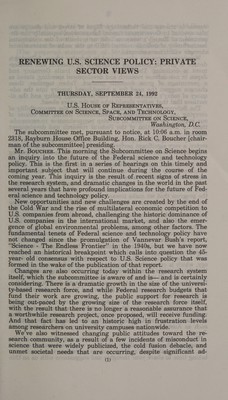
![RENEWING U.S. SCIENCE POLICY: PRIVATE SECTOR VIEWS THURSDAY, SEPTEMBER 24, 1992 U.S. Housrt or REPRESENTATIVES, COMMITTEE ON SCIENCE, SPACE, AND TECHNOLOGY, SUBCOMMITTEE ON SCIENCE, Washington, D.C. The subcommittee met, pursuant to notice, at 10:06 a.m. in room 2318, Rayburn House Office Building, Hon. Rick C. Boucher [chair- man of the subcommittee] presiding. Mr. BoucHer. This morning the Subcommittee on Science begins an inquiry into the future of the Federal science and technology policy. This is the first in a series of hearings on this timely and important subject that will continue during the course of the coming year. This inquiry is the result of recent signs of stress in the research system, and dramatic changes in the world in the past several years that have profound implications for the future of Fed- eral science and technology policy. New opportunities and new challenges are created by the end of the Cold War and the rise of multilateral economic competition to U.S. companies from abroad, challenging the historic dominance of U.S. companies in the international market, and also the emer- gence of global environmental problems, among other factors. The fundamental tenets of Federal science and technology policy have not changed since the promulgation of Vannevar Bush’s report, “Science - The Endless Frontier” in the 1940s, but we have now reached an historical breakpoint which calls into question the 45- year- old consensus with respect to U.S. Science policy that was formed in the wake of the publication of that report. Changes are also occurring today within the research system itself, which the subcommittee is aware of and is— and is certainly considering. There is a dramatic growth in the size of the universi- ty-based research force, and while Federal research budgets that fund their work are growing, the public support for research is being out-paced by the growing size of the research force itself, with the result that’ there is no longer a reasonable assurance that a worthwhile research project, once proposed, will receive funding. And that fact has led to an historic high in frustration levels among researchers on university campuses nationwide. We've also witnessed changing public attitudes toward the re- search community, as a result of a few incidents of misconduct in science that were widely publicized, the cold fusion debacle, and unmet societal needs that are occurring, despite significant ad-](https://iiif.wellcomecollection.org/image/b32218606_0005.jp2/full/800%2C/0/default.jpg)