On the aboriginal inhabitants of the Andaman Islands / by Edward Horace Man. With report of researches into the language of the South Andaman Islands by A. J. Ellis.
- Man, Edward Horace.
- Date:
- [1932]
Licence: In copyright
Credit: On the aboriginal inhabitants of the Andaman Islands / by Edward Horace Man. With report of researches into the language of the South Andaman Islands by A. J. Ellis. Source: Wellcome Collection.
Provider: This material has been provided by London School of Hygiene & Tropical Medicine Library & Archives Service. The original may be consulted at London School of Hygiene & Tropical Medicine Library & Archives Service.
313/334 (page 57)
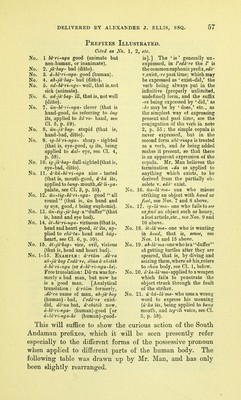
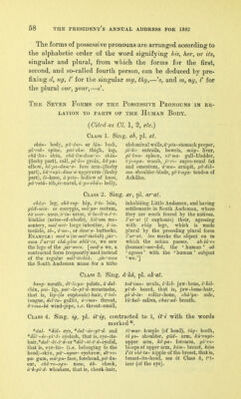
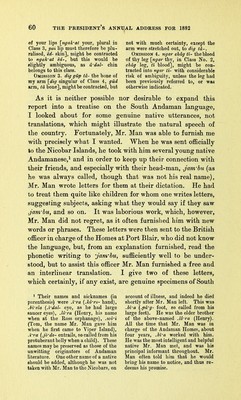
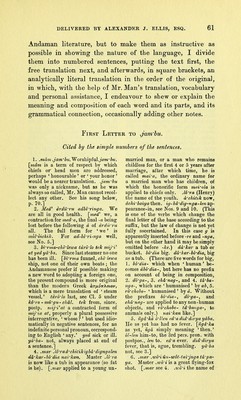
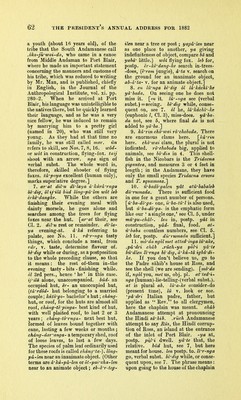
![Prefixes Illustrated. Cited as No. 1, 2, etc. No. 1 bi'ri-nga good (animate but non-human, or inanimate). No. 2. jd'bag- had (ditto). No. 3. d-be'ri-nga- good (human). No. 4. ab-jd-bag- bad (ditto). No. 5. well, that is,not sick (animate). No. 6. iU, that is, not well (ditto). No. 7. iin-be-ri-nga- clever (that is hand-good, iin referring to ong its, applied to ho'ro- hand, see Cl. 6, p. 69). No. 8. un-jd'bag- stupid (that is, hand-bad, ditto). No. 9. ig-he'ri-nga- sharp - sighted (that is, eye-good, ig its, being applied to dal- eye, see Cl. 4, p. 58). No. 10. dull-sighted(thatis, eye-bad, ditto). No. 11. d'kd-he'ri-nga nice - tasted (that is, mouth-good, A‘kd its, applied to bang- vnovXh^de'li-ya- palate, see Cl. 3, p. 58). No. 12. un-tig-be'ri-nga- good “ all round” (that is, un hand and ig eye, good, t being euphonic). No. 13. wn-<i^-_;a'i(i^-a“dufEer”(that is, hand and eye bad). No. 14. virtuous (that is, head and heart good, dt its, ap- plied to che'ta- head and kug- heart, see Cl. 6, p. 69). No. 15. dt-jd'bag- vice, evil, vicious (that is, head and heart had). No. 1-15. Example: a'rtdm .dd'ra ab-jd'bag Vedd're, dmau'chitik d-be'ri-nga (or d-be-ri-nga-ke). Free translation: D 6 ■ ra was for- merly a bad man, but now he is a good man. [Analytical translation : a'rtdm formerly, .do'ra name of man, ab-jd'bag (human) - bad, Vedd-re exist- did, db'na but, d'chitik now, d-be'ri-nga- (human)-good [or d-be'ri-nga-ke (human)-good- is].] The ‘ is ’ generally un- expressed, in Vedd're the V is the common euphonic prefix,erfa' v.exist,-re past time; which may be express^ as ‘ exist-did,’ the verb being always put in the infinitive (properly unlimited, undefined) form, and the suffix -re being expressed by ‘ did,’ as -Ae may be by ‘does,’ etc., as the simplest way of expressing present and past time, see the conjugation of the verb in note 2, p. 55 ; the simple copula is never expressed, but in the second form dbe'ringa i& treated as a verb, and ke being added makes it present, so that there is an apparent expression of the copula. Mr. Man believes the termination -da as applied to anything which exists, to be derived from the partially ob- solete V. eda- exist. No. 16. un-ld'ma- one who misses striking an object with hand or foot, see Nos. 7 and 8 above. No. 17. ig-ld'nia- one who fails to or find an object such as honey, a lost article, etc., see Nos. 9 and 10 above. No. 18. bt-ld'ma- one who is wanting in head, that is, sense, see Nos. 14 and 15 above. No. 19. ai-fd-»nrt-onewhoi3a‘‘duffer” at getting turtles after they are speared, that is, by diving and seizing them,where nb his,refers to chdu body, see Cl. 1, below. No. 20. d-Ao-fd‘»ta-appliedtoaweapon which fails to penetrate the object struck through the fault of the striker. No. 21. d7i;«-f<l wa-who uses a wrong word to express his meaning {d'ka its, being applied to bang mouth, and teg'ili voice, see Cl. 3, p. 58). This will 8uJ6S.ce to show the curious action of the South Andaman prefixes, which it will be seen presently refer especially to the difierent forms of the possessive pronoun when applied to different parts of the human body. The following table was drawn up by Mr. Man, and has only been slightly rearranged.](https://iiif.wellcomecollection.org/image/b24764413_0313.jp2/full/800%2C/0/default.jpg)