On the aboriginal inhabitants of the Andaman Islands / by Edward Horace Man. With report of researches into the language of the South Andaman Islands by A. J. Ellis.
- Man, Edward Horace.
- Date:
- [1932]
Licence: In copyright
Credit: On the aboriginal inhabitants of the Andaman Islands / by Edward Horace Man. With report of researches into the language of the South Andaman Islands by A. J. Ellis. Source: Wellcome Collection.
Provider: This material has been provided by London School of Hygiene & Tropical Medicine Library & Archives Service. The original may be consulted at London School of Hygiene & Tropical Medicine Library & Archives Service.
315/334 (page 59)
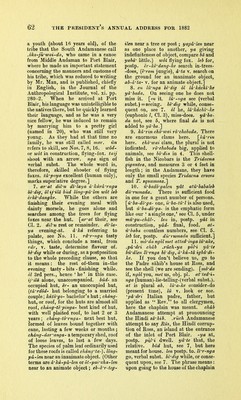
![Class 5. Sing, ong, pi. di'ot. M‘ro- hand or finger,e^mo-palm of the hand and sole of the iw\,lcb-ro-mu'-gu- chal- middle finger, that is, hand-(third of five), [the fourth of five is mii'guch&l taro'lo\ the first is o-tola-- and the second (general) dro'lo-, but (animate) a-riondw- ; the last but one d'totvr- tdrb'lo- ; and the last tdro'lo ; there are only two cardinal numbers ii‘ba-tu'l-oae, and Ikpo-r- two, beyond that they can in general only tap their nose with their fingers, commencing with the little finger, or say drdii-ru several, 10 to 20, jeg-chdu- (human) many, say 50, ji'baba- very many, u'baba- (non- human), but ot-icbaba (lower animals) and atwbaba- (human) countless, a few of the most intelligent natives, however, occasionally use words for numbers up to 7, though different speakers differ as to their precise meaning.] l-ti-pi’l- little finger. hb'-ro-do'ga-thumb,that is, finger-big, tb'go- wrist, ku'tur- knuckle, bd-do- nail of finger or toe (in this sense the 0 of bd-do is inordinately lengthened, to distinguish it from bo'do sun, in which the o is rather of medial length than long, hence we may distinguish bS'do-, nail, and sun),foot, rb'koma- toe, tu ehab- great toe, small toe, gwchul- heel, tdr- ankle, chdg- kidney, td-ga- peritoneum, td'ba- nga- small intestine. Example : dAng kd'ro ngd'ngtek ke'tia-, my hand is smaller than thine, [dong my, kd-ro hand, «yo'«y-t«ithy-from (that is, thy hand-from = than thy hand,correspond- ing precisely to the ablative case after comparative in Latin), kl-tia- small in size (not in quantity, for which bd or do-gaba not much, is used). No mark of second degree of comparison is added, as that is implied by tek.'\ Class 6. Sing. 6t, pi. 6-tot. che-ta- head, Ib-ngota- neck, chdl-ma- chest, mun- brain, yd- occiput, Idp-ta- nape, kd'kd- scalp, d-wa.-\\m%,tu-lepo- phlegm, nl- prostate gland, kug- the seat of the affections and passions, also the bosom, the heart, ku-ktd-bana-ih.e heart itself. Example : .mo-da I'bt che-ta bo-dia- Moda’s head is large, \_.md-da a man’s name, I'ot his, cheta head, bo-diada \axg6.'\ Class 7. Sing, and pi. 6-to. kl-nab- waist, this is apparently the pronoun is used ; it also means ‘ nar- only part of the body for which this row,’ see 48, p. 68. From this determinate use of possessive pronouns arises the custom of omitting the name of the part of the body referred to after a possessive pronoun, where it is clear what it must be. This is especially the case when the word could refer to many parts of the human body, suflBciently distin- guished by the form of the possessive pronoun, as pld- hair, ed- skin, ta- bone, ti- blood, mu-rudi- gore, gu-tnar- sweat, yrlnga- vein, muscle, wavnya- cuticle, de’kia pulse, mun- pus. When any doubt is felt, the full phrase is used. Examples. {Cited as Om. 1, 2, etc.) Omission 1. mo-tot che-ta pld- the hair of our heads. [_md-tot our, see dt No. 6 above, and hence che-ta heads must be taken as plural, pld- hair.] This is contracted into mo-tot pld-, as out of the Class 6 above, it is only the head to which pld- hair applies. Omission 2. ngak-at pai ed- the skin](https://iiif.wellcomecollection.org/image/b24764413_0315.jp2/full/800%2C/0/default.jpg)