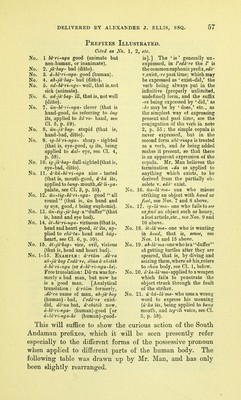
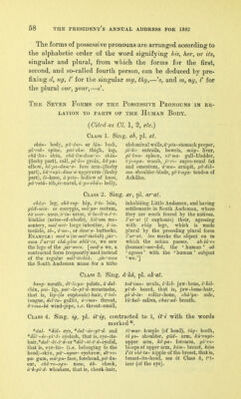
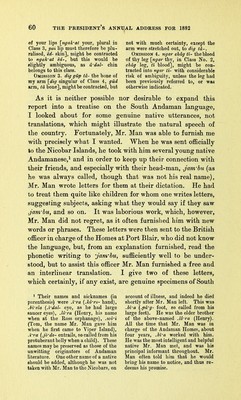
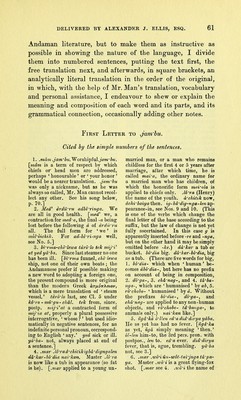
On the aboriginal inhabitants of the Andaman Islands / by Edward Horace Man. With report of researches into the language of the South Andaman Islands by A. J. Ellis.
- Man, Edward Horace.
- Date:
- [1932]
Licence: In copyright
Credit: On the aboriginal inhabitants of the Andaman Islands / by Edward Horace Man. With report of researches into the language of the South Andaman Islands by A. J. Ellis. Source: Wellcome Collection.
Provider: This material has been provided by London School of Hygiene & Tropical Medicine Library & Archives Service. The original may be consulted at London School of Hygiene & Tropical Medicine Library & Archives Service.
316/334 (page 60)
![of your lips \ngak-at your, plural in Class 3, pai lip must therefore be plu- ralised, ed- skin], might be contracted to ngah-at id-, but this would be slightly ambiguous, as a'dal- chin belongs to this class. Omission 3. dig gup t&- the bone of my arm \dig singular of Class 4, gud arm, to. bone], might be contracted, but not with much certainty, except the arm were stretched out, to dig t&-. Omission 4. ngar chag tl- the blood of thy leg \ngar thy, in Class No. 2, chag leg, ti blood], might be con- tracted into ngar ti- with considerable risk of ambiguity, unless the leg had been previously referred to, or was otherwise indicated. As it is neitlier possible nor desirable to expand this report into a treatise on the South Andaman language, I looked about for some genuine native utterances, not translations, which might illustrate the natural speech of the country. Fortunately, Mr. Man was able to furnish me with precisely what I wanted. When he was sent officially to the Nicobar Islands, he took with him several young native Andamanese,^ and in order to keep up their connection with their friends, and especially with their head-man, Jam'bu (as he was always called, though that was not his real name), Mr. Man wrote letters for them at their dictation. He had to treat them quite like children for whom one writes letters, suggesting subjects, asking what they would say if they saw .jam'bu, and so on. It was laborious work, which, however, Mr. Man did not regret, as it often furnished him with new words or phrases. These letters were then sent to the British officer in charge of the Homes at Port Blair, who did not know the language, but, from an explanation furnished, read the phonetic writing to jam'bu, sufficiently well to be under- stood, but to assist this officer Mr. Man furnished a free and an interlinear translation. 1 give two of these letters, which certainly, if any exist, are genuine specimens of South * Their names and nicknames (in parenthesis) were .vra (.ko'ro- hand), .bi-ela {.i-dal- eye, as he had large saucer eyes), ,16-ra (Henry, his name when at the Ross orphanage), .wo-i (Tom, the name Mr. Man gave him when he first came to Viper Island), .i-ra {.jd'do- entrails, so called from his protuberant belly when a child). These names may be preserved as those of the unwitting originators of Andaman literature. One other name of a native should be added, although he was not taken with Mr. Man to the Nicobars, on account of illness, and indeed he died shortly after Mr. Man left. This was .bi-a (.pa-g- foot, so called from his large feet). He was the elder brother of the above-named .lo'ra (Henry). All the time that Mr. Man was in charge of the Andaman Homes, about four years, .bi-a worked with him. He was the most intelligent and helpful native Mr. Man met, and was his principal informant throughout. Mr. Man often told him that he would bring his name to notice, and thus re- deems his promise.](https://iiif.wellcomecollection.org/image/b24764413_0316.jp2/full/800%2C/0/default.jpg)